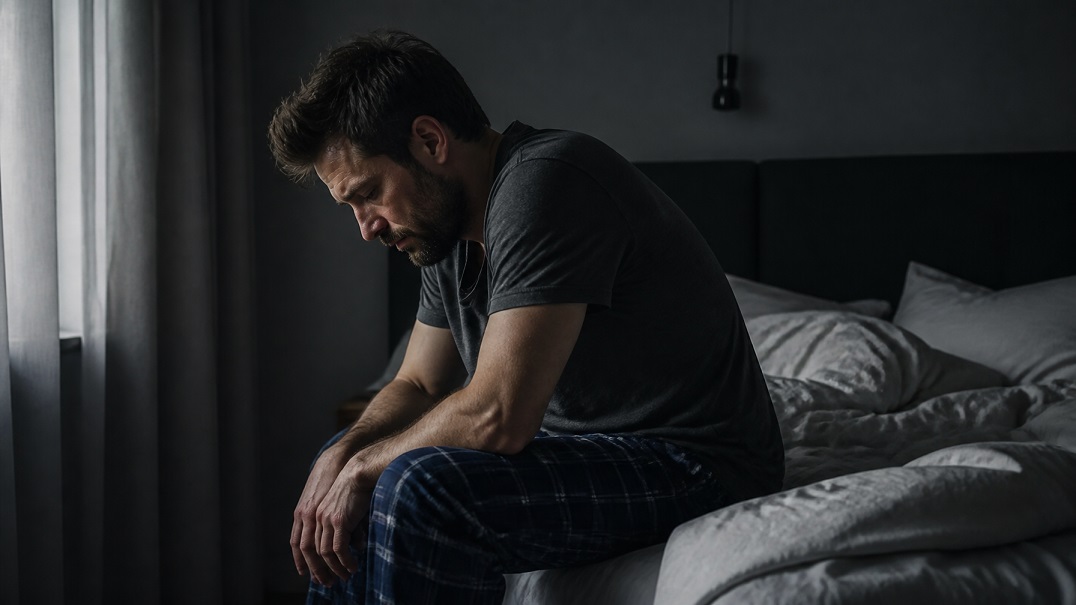
If you’re doing everything right — eating well, lifting weights, managing stress — but still feeling flat, your sleep may be undermining all of it. The relationship between sleep and testosterone is one of the most well-documented in hormonal health, and the findings are striking: even a week of poor sleep can produce measurable drops in testosterone levels in otherwise healthy men.
Most testosterone is released during sleep, particularly during the early cycles of deep, slow-wave sleep and again during REM. The pattern is rhythmic: levels begin climbing shortly after you fall asleep, peak in the morning, and decline across the day. When sleep is cut short, fragmented, or chronically disrupted, that hormonal rhythm breaks down.
This isn’t a minor issue to address eventually. Sleep deprivation is one of the most potent and underappreciated suppressors of testosterone available to modern life. It’s also one of the most fixable. Understanding the mechanism helps you take the problem seriously — and make smarter choices about your nights.
What Happens to Testosterone While You Sleep
Testosterone production doesn’t happen at a steady rate around the clock. It follows a circadian rhythm tightly linked to sleep architecture — the cycling through light sleep, deep sleep, and REM that your brain orchestrates across the night.
The Nightly Surge in T Production
During the first few hours of sleep, your body enters slow-wave sleep — the deepest, most restorative stage. This is when growth hormone is released in its largest pulse of the day, and it’s also when a significant portion of nightly testosterone secretion occurs. As the night progresses and you cycle into REM sleep, testosterone continues to be released in a second, substantial wave.
Research published in Sleep has shown that testosterone levels in men rise progressively during sleep and reach their peak during the first REM episode. Morning testosterone levels — the ones your doctor measures in a blood test — are largely a reflection of how well you slept the night before. Chronic poor sleep doesn’t just affect how you feel; it produces persistently lower baseline testosterone levels over time.
How Much Sleep You Actually Need for Optimal T
A widely cited study from the University of Chicago found that men who slept five hours per night for one week had testosterone levels 10 to 15 percent lower than when they slept a full eight hours. That’s a significant drop — equivalent to aging roughly a decade in hormonal terms, depending on the starting point. The researchers noted that the decline showed up as early as the first week of sleep restriction, and the men reported worsened mood, lower energy, and reduced concentration alongside the hormonal changes.
The threshold for optimal testosterone production appears to be around seven to nine hours for most men, with individual variation. Below six hours, the suppressive effect becomes clinically meaningful. Above nine hours, there’s no clear additional benefit and some evidence suggests that excessive sleep may signal underlying health issues worth addressing separately.
Why Sleep Quality Matters as Much as Duration
Eight hours in bed doesn’t equal eight hours of restorative sleep. Sleep architecture — how much time you spend in each stage — matters enormously, and it deteriorates with age, alcohol use, stress, sleep apnea, and dozens of other factors that many men in their 40s and 50s are quietly contending with.
Sleep Apnea and Testosterone
Obstructive sleep apnea (OSA) is a particularly destructive combination of factors for testosterone. Men with untreated sleep apnea experience repeated oxygen drops throughout the night, which fragment sleep architecture, suppress slow-wave sleep, and elevate cortisol — all of which directly suppress testosterone production.
The relationship runs in both directions. Low testosterone is associated with increased OSA severity, and OSA further suppresses testosterone, creating a compounding loop. Research has found that testosterone levels in men with untreated severe sleep apnea can be substantially below those of healthy controls. Importantly, treating sleep apnea — typically with a CPAP machine — often improves testosterone levels without any other intervention. If you snore heavily, wake unrefreshed regardless of how many hours you spend in bed, or frequently feel sleepy during the day, a sleep study is worth pursuing before you invest further in supplements or other optimization strategies. Your doctor can refer you, or home sleep tests are now widely available.
REM Sleep, Deep Sleep, and Hormonal Recovery
Both REM and deep sleep are linked to testosterone production through different mechanisms. Disruptions that selectively reduce slow-wave sleep — common with aging, alcohol, and certain medications — reduce growth hormone output and impair testosterone release during the first half of the night. Disruptions to REM sleep, which becomes more prominent in the second half of the night, affect the second wave of hormonal activity.
Alcohol, which many men use as a sleep aid, is particularly counterproductive here. It may help you fall asleep faster but it severely suppresses REM sleep, fragments the second half of the night, and elevates cortisol. The net hormonal effect is negative. You can read more about this dynamic in our article on alcohol and testosterone.
The Cortisol Connection
Sleep deprivation raises cortisol — the primary stress hormone — and cortisol and testosterone exist in a direct antagonistic relationship. When cortisol is elevated, testosterone production is suppressed. This is a feature of normal physiology: in a genuine survival situation, you don’t want your body investing energy in reproduction. But chronic sleep deprivation keeps cortisol chronically elevated, which chronically suppresses testosterone.
Cortisol’s Effect on the HPG Axis
The hypothalamic-pituitary-gonadal (HPG) axis is the hormonal signaling chain that regulates testosterone production. Cortisol interferes with this axis at multiple points — it reduces the pulsatile release of gonadotropin-releasing hormone (GnRH) from the hypothalamus, blunts LH secretion from the pituitary, and reduces the sensitivity of the testes to LH signaling. The result is a comprehensive suppression of testosterone synthesis. This is why managing stress, which works through the same cortisol pathway, is so central to maintaining healthy testosterone levels. Our article on how chronic stress kills your testosterone goes deeper on this mechanism.
The Morning Recovery Window
The practical implication of this cortisol–testosterone relationship is that sleep quality directly determines how recovered your hormonal system is each morning. Men who sleep poorly consistently are essentially starting each day in a state of partial hormonal suppression, which compounds over time. A few nights of good sleep won’t fully undo weeks of chronic restriction, but the system does recover relatively quickly when sleep improves — days to weeks rather than months, in most cases.
Practical Steps to Protect Your Sleep and Your Testosterone
Improving sleep for hormonal health is less about biohacking and more about removing the things that reliably undermine it. Most men who struggle with sleep quality are dealing with a combination of behavioral habits, environmental factors, and underlying conditions — each of which is addressable.
Establish a Consistent Sleep Schedule
Your circadian rhythm — the internal clock that governs testosterone release, cortisol timing, and dozens of other biological processes — is calibrated primarily by the consistency of your sleep and wake times. Going to bed and waking at the same time every day, including weekends, stabilizes this rhythm. Men who sleep consistent hours tend to have more predictable and higher morning testosterone levels than those who vary their schedule significantly between weekdays and weekends.
A consistent wake time matters more than a consistent bedtime, because morning light exposure anchors the rhythm. Set an alarm, get up at the same time daily, and your body will regulate the sleep pressure that gets you to bed at the right hour.
Manage Light Exposure
Light is the primary signal your brain uses to calibrate its internal clock. Bright morning light — ideally from actual sunlight — signals that it’s time to be alert and suppresses melatonin. Bright light in the evening, particularly the blue-spectrum light from phones and screens, has the opposite effect: it delays melatonin release, pushes back sleep onset, and often shortens the first slow-wave sleep cycle, which is when testosterone production begins.
Exposure to 10 to 30 minutes of morning sunlight within an hour of waking has measurable effects on circadian entrainment. In the evening, dimming lights two hours before bed and reducing screen brightness matters — though the magnitude of the effect varies by individual sensitivity. Our article on sunlight, vitamin D, and testosterone covers the morning light side of this equation in more detail.
Keep the Bedroom Cool and Dark
Core body temperature drops slightly during sleep, and this drop is part of the sleep initiation signal. A room that’s too warm competes with this process. Most sleep research points to a range of 65 to 68°F (18 to 20°C) as optimal for sleep quality. Blackout curtains or a sleep mask eliminate light that would otherwise suppress melatonin or trigger early morning waking.
Time Your Exercise Appropriately
Exercise is one of the most effective interventions for raising testosterone — but the timing matters for sleep. High-intensity exercise in the two to three hours before bed can elevate cortisol and adrenaline, delaying sleep onset and reducing sleep quality. Training earlier in the day doesn’t carry this risk. If evening workouts are your only option, keeping the intensity moderate and ending at least two hours before bed limits the disruption. For a full discussion of how to use training to raise testosterone, see our guide to the best exercises for boosting testosterone naturally.
Be Strategic About Alcohol
Even moderate alcohol consumption meaningfully disrupts sleep architecture. A drink or two in the evening may be enjoyable, but the data on what it does to REM sleep and cortisol levels is fairly clear. If hormonal optimization is a priority and sleep quality is already suboptimal, this is one of the higher-leverage variables to adjust. Cutting alcohol entirely isn’t the only option — shifting consumption to earlier in the day gives your body more time to metabolize it before sleep begins.
Address Sleep Apnea If It’s Present
This point deserves repetition because it’s often the single most impactful change a man can make. If you have untreated sleep apnea, no amount of sleep hygiene optimization will fully compensate for the fragmentation it causes. Diagnosis requires a sleep study — ask your primary care physician for a referral, or use a home sleep testing service. Treatment is usually straightforward and the hormonal improvements can be substantial.
Supplements That May Support Sleep Quality
Several natural compounds have reasonable evidence for improving sleep quality rather than just sedating you. These aren’t a substitute for fixing underlying sleep habits, but they may be useful once the behavioral foundations are in place.
Magnesium is the most notable. Deficiency is common — estimates suggest a significant portion of the population doesn’t meet the recommended intake — and suboptimal magnesium status is associated with poorer sleep quality and elevated cortisol. Research on magnesium supplementation in older adults has shown improvements in sleep onset, duration, and quality. Our detailed review of magnesium and testosterone covers the evidence. If you’re looking for a cost-effective option, magnesium glycinate or magnesium citrate are well-absorbed forms available in bulk powder from BulkSupplements.com.
Ashwagandha has been studied for both cortisol reduction and sleep quality improvement. One randomized controlled trial found that ashwagandha root extract improved sleep onset latency, total sleep time, and sleep quality scores compared to placebo. Because it works through cortisol reduction rather than direct sedation, it addresses the testosterone connection more directly than many sleep aids. See our full review of ashwagandha and testosterone for the research details.
Melatonin is widely used and effective for sleep onset, particularly for shifting your sleep timing or recovering from jet lag. It’s less effective as a sleep quality enhancer — it doesn’t significantly increase slow-wave or REM sleep in most studies. Low doses (0.5 to 1mg) appear to work as well as higher doses for most men and have fewer morning grogginess effects. Keep expectations calibrated: melatonin helps you fall asleep; it doesn’t fix the architecture of your sleep.
Sleep is the foundation that every other testosterone optimization strategy depends on. Exercise, diet, stress management, and supplementation all produce better results in men who sleep well. If you’re working on your testosterone levels and haven’t addressed sleep quality systematically, that’s the place to start — and based on the research, the payoff is both meaningful and measurable.
Questions Men Ask About Sleep and Testosterone
How quickly does poor sleep affect testosterone levels?
Research shows that even one week of sleeping five hours per night produces measurable testosterone declines — in the range of 10 to 15 percent — in otherwise healthy young men. The effect appears within days, not weeks. Conversely, recovery also happens relatively quickly when sleep improves, though it takes consistent good nights rather than a single good night to restore baseline levels.
Does napping help compensate for lost nighttime sleep?
Napping can help partially offset the cognitive effects of sleep restriction, but it doesn’t replicate the hormonal benefits of nighttime sleep. Most testosterone is released during specific cycles of nocturnal sleep, particularly early slow-wave sleep and REM. A short nap doesn’t produce the same hormonal environment. That said, napping is better than continuing to run a significant sleep debt, and it may help cortisol levels somewhat.
Can treating sleep apnea actually raise testosterone?
Yes, and often meaningfully. Studies on men with obstructive sleep apnea treated with CPAP therapy have found testosterone improvements following treatment — in some cases moving men from a deficient range into a normal one without any other intervention. The improvement comes from restoring sleep architecture and reducing nocturnal cortisol spikes. If you have significant sleep apnea, this is typically the highest-leverage change you can make for testosterone levels.
Does testosterone itself affect sleep quality?
This is a genuine two-way relationship. Low testosterone is associated with poorer sleep quality, more nighttime awakenings, and reduced slow-wave sleep — which then further suppresses testosterone. Men on testosterone replacement therapy sometimes report improved sleep quality, though TRT can also exacerbate sleep apnea in some cases, which is why monitoring is important. You can read more about this dynamic in our article on testosterone and sleep quality.
What’s the best sleep position for testosterone?
Sleep position doesn’t have a direct effect on testosterone production. Where position becomes relevant is in relation to sleep apnea — sleeping on your back tends to worsen airway obstruction in men with OSA, while side sleeping often reduces the severity. If you have or suspect sleep apnea, side sleeping may indirectly support better hormonal outcomes by improving sleep architecture.
Should I take a testosterone booster to make up for lost sleep?
Not as a substitute for fixing sleep. Natural testosterone boosters may provide modest support, but they work best as part of a well-functioning lifestyle foundation — and sleep is the core of that foundation. Running a significant sleep deficit while taking supplements is a bit like trying to fill a bucket with a hole in it. Address the sleep deficit first, then evaluate whether additional supplementation adds value. Our article on whether testosterone boosters actually work provides useful context here.