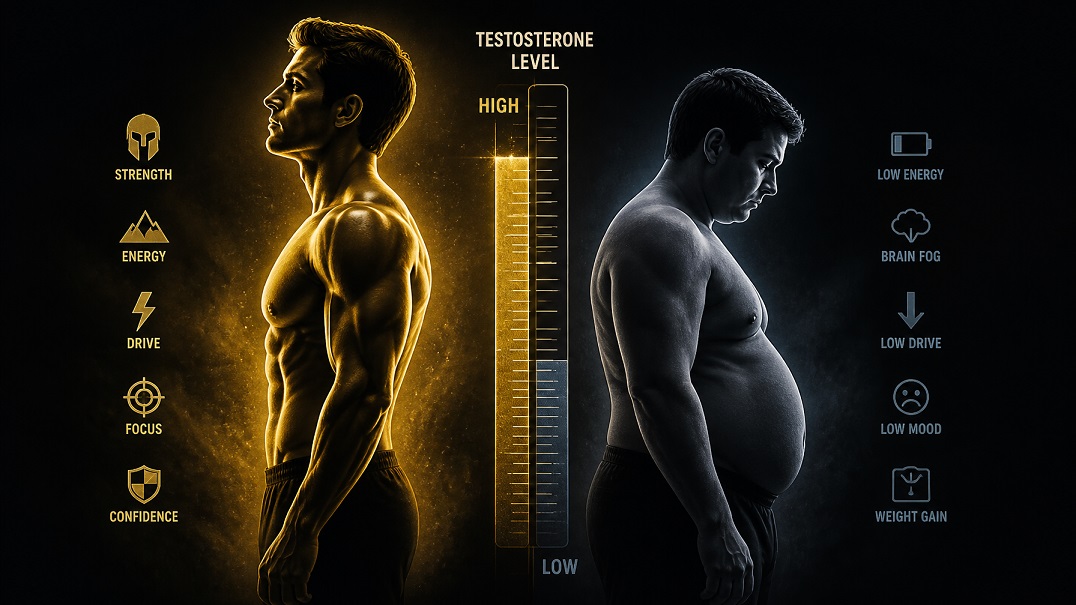
Weight gain and testosterone decline are linked in a self-reinforcing cycle that operates quietly for years before most men recognize it as a system rather than a collection of separate problems. The man who has gradually gained twenty pounds over a decade while simultaneously experiencing declining energy, reduced motivation to exercise, and progressive accumulation of abdominal fat is experiencing the compound output of a biological loop — not simply the consequences of slowing down with age or eating too much.
Understanding this as a cycle rather than a linear cause-and-effect changes the approach. Breaking a cycle requires identifying the most accessible leverage points and intervening at multiple levels rather than attacking a single variable. It also changes the psychology: when weight gain and hormonal decline are understood as mutually causative, the frustration of trying hard to lose weight while testosterone is actively working against those efforts becomes more intelligible — and the case for addressing both simultaneously becomes clearer.
This article covers the specific mechanisms through which testosterone and weight gain reinforce each other, what the research shows about which interventions are most effective for breaking the cycle, and how to think about the sequencing of lifestyle and medical approaches for men who are contending with both problems simultaneously.
How Testosterone Drives Fat Accumulation
Testosterone’s role in body composition extends well beyond its anabolic effects on muscle. It directly influences where and how the body stores fat, how efficiently it burns fat as fuel, and how sensitive cells are to insulin — the hormonal signal most responsible for determining whether incoming energy is stored or metabolized.
Fat Cell Biology and Testosterone
Adipocytes — fat cells — express androgen receptors, and testosterone directly inhibits fat cell differentiation and lipid uptake. In a well-functioning hormonal environment, this androgenic inhibition of fat cell activity limits visceral fat accumulation and promotes fat oxidation as a fuel source. When testosterone declines, this inhibitory effect weakens. Fat cells become more responsive to the signals that promote fat storage and less responsive to those promoting mobilization. The net result is a shift in metabolic partitioning toward fat accumulation — not because caloric intake necessarily increases, but because the hormonal environment has changed in a direction that favors storing incoming energy as fat over using it for metabolic function.
This metabolic partitioning effect helps explain the observation, common among men with declining testosterone, that their body composition is worsening despite dietary habits that haven’t changed significantly. They’re not eating more — the rules governing how their body handles what they eat have changed. This is not an excuse but an explanation, and one that points toward addressing the hormonal environment rather than simply restricting intake further.
Lipolysis and Fat Mobilization
Testosterone promotes lipolysis — the breakdown of stored fat for use as fuel — through effects on adrenergic receptor expression in adipose tissue and through its influence on growth hormone dynamics, which are themselves lipolytic. When testosterone is low, lipolysis is impaired, and the body becomes less efficient at accessing stored fat as an energy source. This reduced fat mobilization contributes to fatigue alongside fat gain — the body has abundant stored energy it can’t access efficiently, which is one of the more frustrating aspects of the hormonal-metabolic combination.
Insulin Sensitivity and Its Role
Testosterone supports insulin sensitivity — the responsiveness of muscle and other tissues to insulin’s signal to take up glucose from the bloodstream. When insulin sensitivity is high, glucose is efficiently directed to muscle and liver, insulin levels stay moderate, and the metabolic environment disfavors fat storage. When testosterone is low and insulin sensitivity declines, more insulin is required to manage equivalent glucose loads, insulin levels rise chronically, and fat storage — particularly visceral fat storage — is promoted.
Insulin resistance and low testosterone create a mutually reinforcing metabolic environment: insulin resistance promotes fat gain, fat gain (particularly visceral fat) increases aromatase activity and suppresses testosterone further, lower testosterone worsens insulin sensitivity, and the cycle deepens. Breaking this insulin-testosterone-fat loop is one of the central challenges in the metabolic management of men with low testosterone and excess body weight.
How Fat Accumulation Suppresses Testosterone
The reverse direction of the cycle — how excess body fat suppresses testosterone — is covered in detail in our article on how body fat affects your testosterone levels. The key mechanisms are aromatase-driven conversion of testosterone to estrogen in visceral fat tissue, estrogen-mediated suppression of HPG axis signaling, inflammatory cytokines from fat tissue impairing testicular function, and the insulin resistance that impairs the metabolic environment for testosterone production.
The practical implication is that fat gain and testosterone decline accelerate each other in a compounding trajectory. A man who gains fifteen pounds of visceral fat over two years doesn’t simply have lower testosterone because of those fifteen pounds — the lower testosterone that resulted from those fifteen pounds makes the next fifteen pounds more likely, faster, and harder to reverse. Each turn of the cycle makes the next turn worse.
The Muscle Loss Component
The weight gain side of the testosterone-fat cycle is further complicated by simultaneous muscle loss. Low testosterone impairs muscle protein synthesis and accelerates sarcopenia — the age-related loss of lean muscle mass covered in our article on testosterone and muscle loss. As muscle is lost alongside fat gain, the metabolic consequences compound: resting metabolic rate falls (since muscle is metabolically expensive tissue that burns calories at rest), making further fat gain more likely at equivalent caloric intake, and the hormonal stimulus that muscle provides for testosterone production is reduced.
This simultaneous fat gain and muscle loss — sometimes called sarcopenic obesity — is one of the more challenging body composition states to address because the interventions for each problem interact. Aggressive caloric restriction, which would address the fat gain, also accelerates muscle loss. Aggressive resistance training, which would address the muscle loss and support testosterone, is more difficult in men who are significantly deconditioned and whose recovery capacity is impaired by low testosterone. The simultaneous approach — moderate caloric deficit combined with adequate protein and progressive resistance training — is more effective than either alone but requires more sustained effort and more careful implementation.
Behavioral and Motivational Dimensions of the Cycle
The testosterone-weight gain cycle has a behavioral dimension that is as important as the biological one. Low testosterone reduces motivation and energy — the drive to exercise, the willingness to sustain dietary discipline, the capacity to maintain effort in the face of slow progress. When a man’s hormonal environment has shifted toward fatigue, low motivation, and reduced resilience to frustration, the behavioral demands of sustained weight loss are significantly harder to meet than they would be in a more favorable hormonal state.
This creates a situation where the men who most need to exercise and improve their diet for testosterone recovery are also the men whose hormonal state most impairs the motivation and energy to do so. The advice to simply exercise more and eat better is not wrong — it’s necessary — but it fails to acknowledge the biological headwind that makes it considerably harder than it sounds for men in the depths of the cycle. This is one reason that addressing the hormonal dimension alongside the behavioral one — through both medical evaluation and lifestyle intervention simultaneously — tends to produce better outcomes than sequential approaches.
Our article on how low testosterone affects your energy all day long covers the energy dimension in detail, and our article on testosterone and motivation addresses the motivational component.
What the Evidence Shows About Breaking the Cycle
The research on interrupting the testosterone-weight gain cycle points consistently toward a combination of approaches rather than any single intervention.
Fat Loss Raises Testosterone — But How You Lose It Matters
The evidence that meaningful fat loss raises testosterone in overweight men is well established and covered in detail in our article on whether losing weight can raise your testosterone. The key finding for the cycle-breaking context is that the approach to fat loss significantly affects the hormonal response. Aggressive caloric restriction produces cortisol elevation that suppresses testosterone during active restriction — the body interprets severe energy deficit as a threat and prioritizes cortisol over testosterone production. Moderate, sustained deficits with adequate protein and resistance training produce better hormonal outcomes than rapid weight loss through extreme restriction.
The research on bariatric surgery — which produces the largest and most rapidly documented testosterone improvements from weight loss — shows testosterone increases that can be dramatic when the weight loss is substantial. But surgery also imposes nutritional absorption challenges and carries its own risk profile. For most men, the goal is a weight loss approach that progressively improves the hormonal environment rather than one that briefly suppresses it further in pursuit of rapid results.
Resistance Training as the Central Intervention
Progressive resistance training is the intervention with the strongest evidence for simultaneously addressing multiple points in the testosterone-weight gain cycle. It directly stimulates testosterone production through acute and chronic hormonal responses to heavy exercise. It builds lean muscle mass, raising resting metabolic rate and improving insulin sensitivity. It preferentially mobilizes visceral fat over time, reducing the primary source of aromatase-driven testosterone suppression. And it provides the competitive, achievement-oriented challenge that supports testosterone through the behavioral and neurochemical mechanisms discussed in our article on the best exercises for boosting testosterone naturally.
Men who begin resistance training while in the testosterone-weight gain cycle often find that initial progress is slower than expected — both because the hormonal environment limits muscle protein synthesis efficiency and because significant deconditioning requires more ramp-up time than training at optimal fitness would. The early weeks may feel discouraging. The evidence, however, supports persistence: even in men with low testosterone and significant excess body fat, consistent resistance training produces progressive improvements in body composition and hormonal markers that compound meaningfully over months.
Dietary Approaches That Target Visceral Fat and Insulin Sensitivity
The dietary approaches most effective for breaking the testosterone-weight gain cycle share a common focus: improving insulin sensitivity and preferentially reducing visceral fat rather than simply reducing total body weight. Reducing refined carbohydrates and added sugars — the primary dietary drivers of insulin spikes that promote visceral fat accumulation — appears to be among the highest-leverage dietary changes for men with insulin resistance and excess abdominal fat. Adequate protein intake preserves muscle during a caloric deficit and supports testosterone through the direct nutritional requirements of steroidogenesis. Quality dietary fat from whole food sources provides the cholesterol and fatty acid substrate for testosterone synthesis.
Our article on the testosterone-friendly diet covers the specific dietary pattern most supportive of hormonal health, and our article on intermittent fasting and testosterone addresses one dietary timing approach that some men find effective for visceral fat reduction.
When to Consider TRT as Part of the Approach
For men with confirmed, significant testosterone deficiency in the context of overweight and metabolic dysfunction, the question of whether to pursue testosterone replacement therapy alongside lifestyle intervention is a genuinely complex clinical judgment. The case for TRT in this context is that restoring testosterone can break the hormonal side of the cycle — improving insulin sensitivity, supporting muscle protein synthesis, reducing fat accumulation, and improving the energy and motivation that make lifestyle intervention more sustainable. Studies on TRT in hypogonadal men consistently show improvements in body composition alongside hormonal normalization, particularly when combined with exercise.
The standard recommendation is to pursue meaningful lifestyle intervention first and reassess testosterone after three to six months of sustained effort — partly because lifestyle changes may raise testosterone enough to avoid TRT, and partly because a man who has improved his lifestyle will respond better to TRT if he ultimately needs it. For men with very low testosterone where lifestyle intervention alone is making insufficient progress, initiating TRT earlier to remove the biological headwind may be warranted. Our article on who is a good candidate for TRT covers the candidacy assessment in detail, and our article on TRT versus natural testosterone boosters helps frame the options.
Questions Men Ask About Testosterone and Weight Gain
Is my weight gain actually caused by low testosterone, or is it the other way around?
Almost certainly both, operating simultaneously. The testosterone-weight gain relationship is bidirectional by definition — each direction is well documented independently, and in most men with both problems, both directions are active. The more practically useful question is which direction entered first and which is currently dominant, because this affects the sequencing of intervention. If testosterone was clearly declining before significant weight gain occurred, the hormonal picture may be more primary. If weight gain preceded significant hormonal symptoms, the metabolic and fat-driven suppression may be more primary. In practice, both need to be addressed regardless of which came first.
Why does it feel impossible to lose weight when my testosterone is low?
Because it genuinely is harder — not impossibly harder, but significantly harder than it would be in a more favorable hormonal environment. Reduced lipolysis means the body accesses stored fat less efficiently. Insulin resistance means more energy gets stored as fat rather than used for metabolic function. Muscle loss reduces resting metabolic rate. Reduced motivation and energy impair the behavioral consistency that weight loss requires. And cortisol, which is often chronically elevated alongside low testosterone, actively promotes visceral fat storage. None of this makes weight loss impossible, but it explains why men in this state often feel that their effort isn’t producing the results that equivalent effort produced earlier in life — because hormonally, it isn’t.
How much weight do I need to lose for testosterone to meaningfully improve?
Measurable testosterone improvements begin with modest fat loss — some research finds improvements with as little as five percent of body weight lost when starting from an overweight baseline. More meaningful hormonal recovery typically requires ten to fifteen percent or more of initial weight lost, primarily as fat with muscle preserved. The improvements continue to accumulate with further fat loss, particularly as visceral fat — which carries the most significant aromatase burden — is progressively reduced. There’s no single threshold; the hormonal response is continuous, and any meaningful fat loss in an overweight man contributes to improved testosterone.
Can I lose fat and build muscle at the same time when testosterone is low?
Simultaneous fat loss and muscle gain — body recomposition — is possible, particularly in men who are newer to resistance training or who are significantly deconditioned. The degree to which it’s achievable is limited by the hormonal environment: testosterone-deficient men have reduced muscle protein synthesis efficiency, making muscle gain during a caloric deficit more difficult than it would be with normal testosterone. The practical approach for most men in this situation is to prioritize fat loss with muscle preservation rather than muscle gain while losing fat — accepting that lean mass gains will be modest or deferred until hormonal recovery supports a more anabolic environment.
Will testosterone treatment cause weight gain?
No — testosterone treatment in hypogonadal men consistently shows improvements in body composition, not worsening. Total body weight may remain stable or increase modestly on TRT because lean mass gains can offset or exceed fat mass reductions, but the composition change is favorable: more muscle, less fat, particularly less visceral fat. Men who gain total weight on TRT while their body composition improves are gaining the metabolically beneficial tissue (muscle) while losing the hormonally and metabolically harmful tissue (visceral fat). This is a favorable outcome even when the scale doesn’t reflect it immediately.
Is the testosterone-weight cycle reversible after many years?
Yes, substantially, though the degree of reversibility depends on how long the cycle has been operating, the severity of both the testosterone deficiency and the excess body fat, and age-related limitations on testicular function recovery. Functional hypogonadism — the type of testosterone suppression caused by the metabolic and hormonal environment of obesity — is by definition potentially reversible when the environmental factors are addressed. Primary testicular insufficiency, where the testes have lost productive capacity, is less reversible. Most overweight men with low testosterone have a significant functional component, and meaningful fat loss typically produces meaningful testosterone recovery — sometimes fully into the normal range, sometimes partially, with the extent depending on individual factors including baseline testicular reserve.