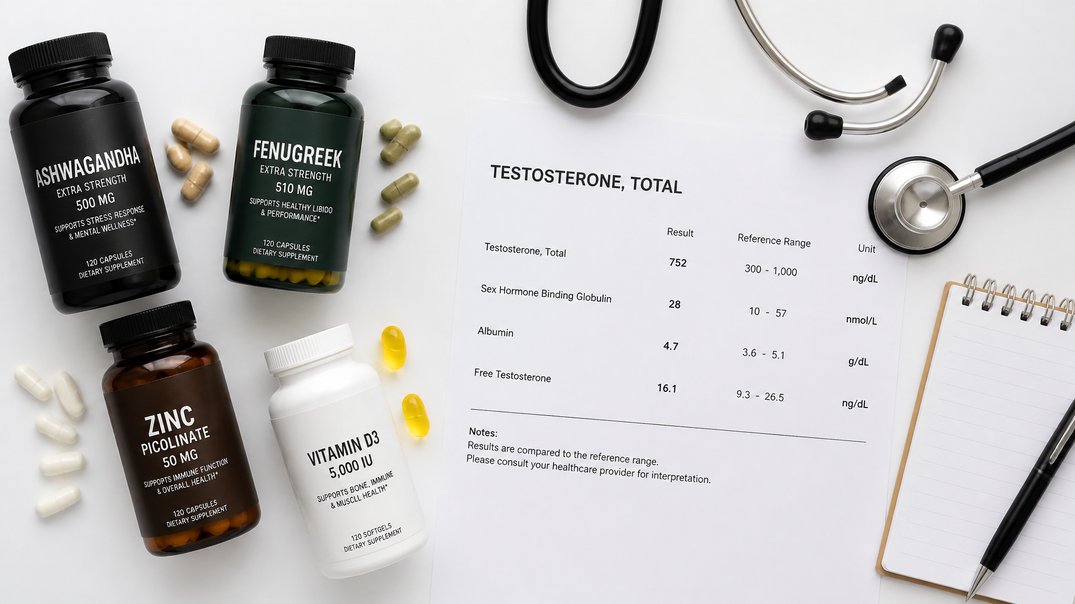
Every testosterone booster on the market has an ingredient list. Some have five ingredients, some have fifteen. Some lead with ashwagandha, some with Tongkat Ali, some with D-aspartic acid. A few feature ingredients you’ve never heard of alongside ones that have a genuine research base. Without a framework for prioritizing what actually matters, the ingredient list is just a list — impressive-sounding names that don’t help you make a better decision.
This article provides that framework. It identifies the ingredients with the strongest evidence for supporting testosterone in men, explains why they matter more than others, and describes how to think about prioritization when you’re evaluating any product. It also addresses which commonly included ingredients are worth less attention than their marketing receives, and why understanding both sides of that distinction matters as much as knowing what to look for.
The full evidence base for each ingredient covered here is in the Natural Ingredients category. This article synthesizes that evidence into a prioritized perspective for the specific purpose of evaluating multi-ingredient products.
Tier One: The Nutritional Foundation
The highest-priority ingredients in any testosterone booster are the essential nutrients with well-established roles in testosterone production and the most consistent evidence for meaningful hormonal effects when deficiency is corrected. These are not the most exciting ingredients on a label — they don’t have exotic names or dramatic backstories — but they are the ingredients where the evidence is most robust and the potential benefit most reliable.
Any testosterone booster that omits all three of these, or includes them at doses too low to matter, is missing the most evidence-backed part of the natural testosterone support picture.
Vitamin D3
Vitamin D is arguably the single most important ingredient in any testosterone booster, for two reasons. First, deficiency is extraordinarily prevalent — affecting the majority of men in Western countries during winter months and a substantial proportion year-round. Second, the evidence linking deficiency correction to meaningful testosterone improvement is among the strongest and most consistent in the natural supplements space.
As covered in Vitamin D and Testosterone: What the Research Says, vitamin D3 acts directly on Leydig cells in the testes through vitamin D receptors, influences the hypothalamic-pituitary signaling chain, and has been associated with SHBG reduction. A randomized controlled trial found approximately 25 percent increases in testosterone in deficient men supplementing vitamin D3 over one year.
What to look for: vitamin D3 (not D2) at 1,000 to 3,000 IU minimum per daily serving. Men with likely deficiency — those living at higher latitudes, spending significant time indoors, or over 50 — benefit from the higher end of this range or above. Products including only 400 IU are providing a token amount that is unlikely to meaningfully correct deficiency in most men.
Zinc
Zinc is a direct cofactor in the enzymatic pathways of testosterone synthesis, a natural aromatase inhibitor, and essential for LH function. Men who are zinc insufficient — more common than most realize, particularly those with limited red meat intake, those who exercise heavily, or those who drink alcohol regularly — experience genuinely suppressed testosterone production as a consequence. Correcting that deficiency restores production capacity.
As covered in Zinc and Testosterone: What the Research Says, the form of zinc matters as much as the dose. Zinc picolinate and zinc bisglycinate are substantially better absorbed than zinc oxide, which is the most common and cheapest form. A product containing zinc oxide at 11 mg is providing less usable zinc than one containing zinc bisglycinate at 15 mg, despite the higher milligram count on the former.
What to look for: 15 to 30 mg of elemental zinc in a bioavailable form (picolinate, bisglycinate, or citrate). Products listing zinc oxide as the sole zinc source score lower on this criterion regardless of the milligram amount.
Magnesium
Magnesium insufficiency is the most prevalent nutrient deficiency in Western adult populations, and it affects testosterone through multiple pathways: direct inhibition of SHBG binding affinity (increasing free testosterone), support of steroid hormone synthesis enzymes, sleep quality improvement (which supports testosterone production during deep sleep), and cortisol regulation.
As covered in Magnesium and Testosterone: What the Research Says, the form distinction is again critical. Magnesium glycinate is among the best-absorbed and best-tolerated forms, with additional sleep-supporting properties from its glycine component. Magnesium oxide — the most common form in inexpensive products — has approximately 4 percent bioavailability and is largely ineffective for hormonal support purposes despite its widespread use.
What to look for: 200 to 350 mg of elemental magnesium in a bioavailable form (glycinate, malate, or taurate). Products using magnesium oxide score poorly on this criterion regardless of amount.
Tier Two: The Herbal Workhorses
These are the herbal ingredients with the most credible and consistent clinical evidence for testosterone-supporting effects in human populations. They work through mechanisms that complement the nutritional foundation — cortisol modulation, SHBG reduction, and conversion enzyme inhibition — and their presence at effective doses is the primary differentiator between well-formulated and poorly formulated products in this category.
Ashwagandha (Standardized Root Extract)
Ashwagandha has the most extensive clinical research base of any herbal ingredient in the testosterone category. Multiple randomized controlled trials using KSM-66 — the most research-backed standardized extract — have found significant testosterone improvements in men with elevated cortisol and stress-related hormonal suppression. The cortisol-reduction mechanism is its primary pathway, making it most effective for men whose testosterone is being suppressed by chronic stress.
As covered in Ashwagandha and Testosterone: What the Research Says, the extract form matters considerably. KSM-66 (standardized to minimum 5 percent withanolides from root only) and Sensoril are the extracts with direct research support. Generic ashwagandha root powder without standardization information provides unpredictable active compound content.
What to look for: 300 to 600 mg of KSM-66 or equivalent standardized root extract. Products listing ashwagandha below 200 mg or as unstandardized root powder are delivering uncertain and likely insufficient active compound content.
Tongkat Ali (Standardized Water-Soluble Extract)
Tongkat Ali has a well-developed research base for testosterone support, with its primary mechanism involving reduction of SHBG binding affinity — freeing more existing testosterone into the active fraction. Some research also supports effects on LH secretion and cortisol reduction. Its effects are particularly relevant for men whose free testosterone is disproportionately low relative to total testosterone — a pattern consistent with elevated SHBG.
As covered in Tongkat Ali and Testosterone: What the Research Says, LJ100 — a patented water-soluble extract standardized to specific eurypeptide and glycosaponin levels — has the strongest direct research support. Generic Tongkat Ali root powder without standardization is less predictable in its active compound content.
What to look for: 200 to 400 mg of a standardized water-soluble extract, ideally LJ100 or a comparable preparation specifying eurypeptide content. Products containing only “Tongkat Ali root” without standardization information provide less reliable dosing.
Fenugreek (Standardized Saponin Extract)
Fenugreek works primarily through inhibition of aromatase and 5-alpha reductase — the enzymes that convert testosterone into estradiol and DHT respectively. By slowing these conversions, it preserves more testosterone in its active form. The most consistent research findings involve improvements in free testosterone and testosterone-related outcomes including sexual function, with less consistent evidence for total testosterone increases.
As covered in Fenugreek and Testosterone: What the Research Says, Testofen — standardized to 50 percent fenuside saponins — is the extract form used in most positive clinical research. Generic fenugreek seed powder has variable saponin content and less predictable effects.
What to look for: 500 to 600 mg of a standardized saponin extract (Testofen or equivalent specifying saponin percentage). Products listing unstandardized fenugreek seed powder below 400 mg are unlikely to deliver meaningful free testosterone effects.
Tier Three: Valuable Supporting Ingredients
These ingredients have meaningful evidence for specific mechanisms relevant to testosterone support, but their benefit is more conditional, more population-specific, or less extensively documented than the Tier One and Tier Two ingredients. They add genuine value to a well-formulated product when present at effective doses, but their absence doesn’t necessarily indicate a poor product, and their presence at sub-clinical doses doesn’t rescue a formula that’s missing the higher-tier ingredients.
Boron
Boron has consistent evidence for SHBG reduction and estradiol lowering at supplemental doses, with one study finding a 28 percent increase in free testosterone after just one week of supplementation. Its primary value is in the free testosterone space — increasing the bioavailable fraction without necessarily affecting total production. It’s also inexpensive to include at effective doses, making its absence in otherwise quality products harder to justify.
What to look for: 6 to 10 mg daily. This is a small amount that shouldn’t require meaningful space in any formula, making products that omit it or include only 1 to 2 mg harder to defend on formulation grounds.
Shilajit (Purified, Standardized)
Shilajit’s unique mitochondrial mechanism — supporting the cellular energy supply that testosterone synthesis depends on — is genuinely distinct from every other ingredient in the category. The primary human testosterone study found approximately 20 percent increases in both total and free testosterone in middle-aged men over 90 days. Its conditional nature — product quality being critically important given heavy metal contamination risks in inadequately processed products — means that its value in a multi-ingredient formula depends heavily on the quality of the specific shilajit extract used.
What to look for: 250 to 500 mg of purified shilajit standardized to fulvic acid content (50 percent or above), from a manufacturer with third-party testing for heavy metals. Generic shilajit resin or powder without quality verification is a quality concern regardless of dose.
Panax Ginseng (Standardized Extract)
Panax ginseng’s evidence for direct testosterone increases is less consistent than for the higher-tier herbal ingredients, but its documented effects on energy, sexual function, stress resilience, and cognitive sharpness make it highly relevant to the “Whole Man” framing of this site. Its inclusion in a formula targeting overall male vitality rather than testosterone numbers alone is well-justified by the evidence.
What to look for: 200 to 600 mg of standardized extract specifying ginsenoside percentage, or Korean red ginseng preparations. Generic ginseng powder without standardization is less reliable.
Nettle Root
Nettle root’s SHBG-binding mechanism — competing directly with testosterone for SHBG binding sites — adds a complementary SHBG-targeting approach to Tongkat Ali and boron. Its additional evidence for prostate health support makes it particularly relevant for men over 50. The human clinical evidence for direct testosterone effects is thinner than for higher-tier ingredients, but the mechanistic rationale is specific and coherent.
What to look for: 300 to 600 mg of standardized root extract (not leaf). Products listing “nettle” without specifying root may not be providing the relevant active compounds.
Ingredients With Weaker Evidence Than Their Reputation Suggests
Understanding which ingredients are consistently over-included in formulas relative to their actual evidence is as valuable as knowing which ones to prioritize. These are the ingredients that appear frequently and sound impressive but whose evidence for testosterone specifically doesn’t justify the space they take up in many formulas.
Tribulus Terrestris
Tribulus terrestris may be the most over-included ingredient in the testosterone booster category relative to its evidence. It has been extensively studied in human populations and has consistently failed to demonstrate significant testosterone increases compared to placebo in well-designed trials. Its traditional reputation and exotic-sounding name have kept it popular in formulas long after the research established its limitations. Unless a product is offering something specifically supported by tribulus research — which is limited to modest effects on sexual function in some populations, not testosterone — its prominent inclusion is a label quality concern rather than a feature.
Maca Root
Maca root has genuine evidence for improving sexual function, libido, and energy — but not for increasing testosterone levels. Multiple well-designed studies have examined maca’s effects on testosterone and found no significant changes. It’s a useful ingredient for overall male vitality in the functional sense, but including it on the strength of its testosterone reputation is not well-supported. Products that list maca prominently in the context of testosterone support are stretching the evidence.
D-Aspartic Acid (Conditionally)
D-Aspartic acid occupies an unusual position — as discussed in D-Aspartic Acid and Testosterone: What the Research Says, its evidence is genuinely conditional on baseline testosterone status. It may be meaningful for men with low testosterone; it appears ineffective and potentially counterproductive for men with normal levels. Its inclusion is therefore not a positive or negative signal without context — it depends on who the target population is and whether the dose (approximately 3 grams) is present. At sub-clinical doses in a proprietary blend, it’s a label decoration. At 3 grams in a transparent formula targeting men with low T, it has a rationale.
Horny Goat Weed (Epimedium)
Epimedium has some evidence for PDE5 inhibition — the same mechanism as pharmaceutical erectile dysfunction treatments — through its compound icariin, though the concentrations required and the icariin content of most supplement preparations make the practical significance uncertain. It has limited credible evidence for direct testosterone effects in humans. Its consistent appearance in testosterone booster formulas reflects marketing tradition more than evidence-based formulation.
How to Prioritize When No Product Has Everything
The reality of the testosterone booster market is that no single product includes all the highest-priority ingredients at fully effective doses. Formulation constraints — capsule capacity, cost, palatability — mean that every product involves trade-offs. The prioritization framework matters for evaluating those trade-offs intelligently.
A product that contains vitamin D3 at 3,000 IU, magnesium glycinate at 300 mg elemental, zinc bisglycinate at 20 mg elemental, KSM-66 ashwagandha at 600 mg, and Tongkat Ali LJ100 at 200 mg has covered the Tier One nutritional foundation and the two most evidence-backed herbal ingredients. That’s a genuinely strong core formula. Its omission of fenugreek, boron, and shilajit is a trade-off worth noting but not a deal-breaker.
A product that contains the same five ingredients but replaces magnesium glycinate with magnesium oxide, replaces zinc bisglycinate with zinc oxide, and reduces ashwagandha to 100 mg of generic root powder has technically the same ingredients but a meaningfully inferior formula — because the form and dose decisions undermine what the ingredient list promises.
The evaluation framework from What to Look for in a Testosterone Booster (And What to Ignore) applied to the ingredient prioritization in this article gives you the tools to make these distinctions reliably.
Questions Men Ask About Testosterone Booster Ingredients
Which Single Ingredient Is Most Important in a Testosterone Booster?
Vitamin D3 has the strongest case for this designation, primarily because deficiency is so prevalent and the evidence for testosterone improvement with deficiency correction is so consistent. If a man has unaddressed vitamin D deficiency — which applies to the majority of men in Northern latitudes for at least part of the year — no amount of herbal ingredients will compensate for that foundational gap. Zinc and magnesium make a close second and third by the same reasoning. The herbal ingredients work best on top of an adequate nutritional foundation, not in place of it.
Is Ashwagandha or Tongkat Ali More Important?
They work through different mechanisms and serve different needs. Ashwagandha is most valuable for men whose testosterone is being suppressed by chronic stress and elevated cortisol — a very common situation. Tongkat Ali is most valuable for men whose primary concern is high SHBG reducing free testosterone availability. For men with both issues, both are valuable and their mechanisms are complementary. If a product must choose between them, the right answer depends on which mechanism is most relevant to the individual man’s situation.
Why Is Tribulus Terrestris Still in So Many Products if the Evidence Is Weak?
Primarily because it has been in testosterone booster formulas since before the modern evidence base existed, and consumer recognition of the name creates a perceived value that manufacturers are reluctant to abandon. Marketing momentum sustains ingredients in formulas long after the research has clarified their limitations. The supplement industry doesn’t automatically update its formulas when new research challenges established ingredients — it updates them when consumer demand or competitive pressure requires it.
Does Every Testosterone Booster Need D-Aspartic Acid?
No. As the evidence article for D-aspartic acid explains, its benefit is most clearly established in men with genuinely low testosterone and less likely to be meaningful — possibly counterproductive — in men with normal levels. For products targeting the broader market of men with subclinical hormonal decline rather than clinical deficiency, DAA’s conditional evidence makes it a lower-priority inclusion than the Tier One and Tier Two ingredients. Its presence in a formula is not a positive signal in itself; its dose and the context of the target population are what determine its relevance.
How Can a Product With Fewer Ingredients Be Better Than One With More?
Because effective dosing requires space, and space in a capsule-based supplement is finite. If a product has 2,800 mg of total ingredient capacity per daily serving and contains fourteen ingredients, the average dose is 200 mg per ingredient. Many of the key ingredients require far more than 200 mg at clinically effective doses — ashwagandha needs 300 to 600 mg, fenugreek needs 500 to 600 mg. A product that focuses on five or six ingredients can dose each of them appropriately within the same physical constraints. Ingredient count is a marketing feature; effective ingredient dosing is a quality feature.
Should I Look for “Clinically Studied” Ingredients?
Yes, but with appropriate skepticism about what that phrase means. “Clinically studied” can mean anything from a rigorous multi-site randomized controlled trial to a single unpublished study funded by the ingredient manufacturer. The phrase on a label tells you that someone, somewhere, studied the ingredient — it doesn’t tell you the quality of that study, the population studied, or whether the findings were positive. The relevant question is not whether an ingredient has been studied but what the best available evidence shows about its effects at the dose included in the product.