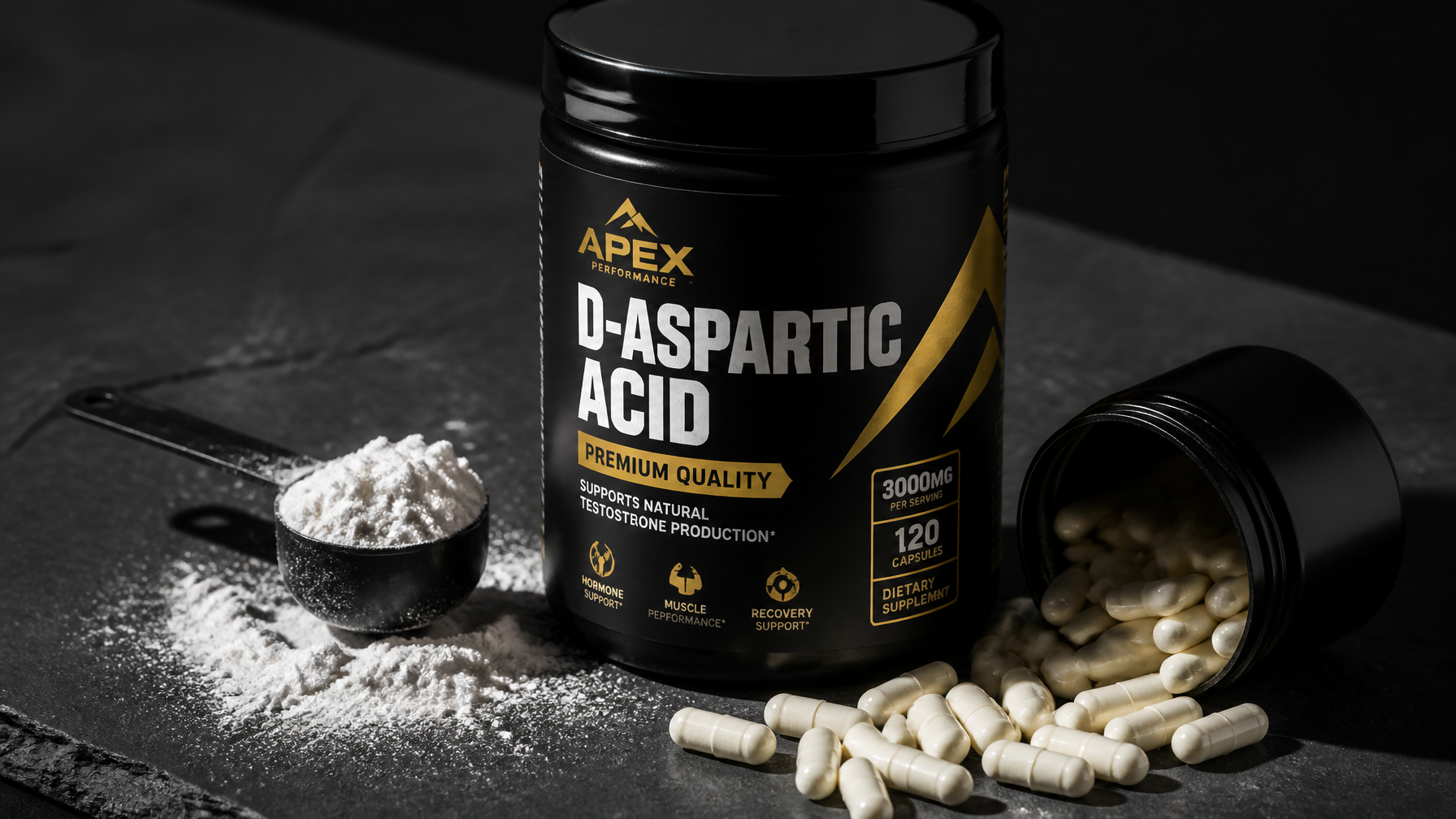
D-Aspartic acid — commonly abbreviated DAA — is one of the most frequently included ingredients in commercial testosterone boosters, and also one of the most misrepresented. It generated considerable excitement when early research appeared to show substantial testosterone increases, and that excitement drove its inclusion in a large number of products before more complete research could complicate the picture. The complete picture is considerably more nuanced than the initial findings suggested.
D-Aspartic acid is an amino acid — specifically the D-form of aspartic acid, which is the mirror image of the more common L-aspartic acid. The D-form is found naturally in the brain, pituitary gland, and testes, where it plays specific roles in hormone synthesis and signaling. It is not an essential amino acid, meaning the body can produce it, but it concentrates in tissues where testosterone-related signaling is active — which is what prompted researchers to investigate whether supplementing with it could support testosterone production.
This article covers how D-aspartic acid is proposed to work, what the research actually shows across different study populations, why the results are more complicated than early findings suggested, and what this means for men considering it as a supplement.
How D-Aspartic Acid Is Thought to Influence Testosterone
The proposed mechanisms for D-aspartic acid’s effects on testosterone are reasonably well-understood at the biological level, even if the translation to practical supplementation outcomes has proven more variable than the mechanisms alone would predict.
Stimulation of LH Release in the Pituitary
D-Aspartic acid accumulates in the pituitary gland, where research has found it stimulates the release of luteinizing hormone (LH) — the pituitary hormone that signals the Leydig cells in the testes to produce testosterone. This is an upstream mechanism: rather than acting directly on testosterone synthesis in the testes, DAA operates at the level of the signaling system that drives production.
The pituitary mechanism is supported by both animal research and the initial human studies that established D-aspartic acid as a testosterone-relevant compound. It provides a biologically plausible explanation for why supplementation might increase testosterone — by turning up the hormonal signal that tells the testes to produce more.
Direct Action in the Testes
Beyond the pituitary, D-aspartic acid is also found in the testes themselves, where it appears to influence the rate-limiting step in testosterone synthesis — the conversion of cholesterol to pregnenolone — by stimulating the steroidogenic acute regulatory (StAR) protein. StAR facilitates the transport of cholesterol into the mitochondria of Leydig cells, where it can be converted to testosterone precursors. This direct testicular mechanism operates in parallel with the upstream LH pathway.
Together, these two mechanisms — increased LH signaling from the pituitary and enhanced steroidogenic activity in the testes — suggest that D-aspartic acid could meaningfully support testosterone production through a pathway distinct from the SHBG modulation, enzyme inhibition, and cortisol reduction mechanisms described for other ingredients in this category.
The Self-Regulating Problem
There is a significant complication in the D-aspartic acid mechanism that distinguishes it from simpler nutritional interventions and helps explain why the clinical results have been inconsistent. The same enzyme that produces D-aspartic acid in the testes — aspartate racemase — is upregulated by testosterone itself. This means that as testosterone rises in response to DAA supplementation, the production and clearance of D-aspartic acid in testicular tissue may accelerate, potentially limiting the sustained effect of exogenous supplementation.
In other words, the body appears to regulate D-aspartic acid levels in a testosterone-dependent way, which creates a natural ceiling on how much testosterone increase sustained supplementation can produce — and may explain why some studies find initial increases that diminish or disappear with longer supplementation periods.
What the Clinical Research Actually Shows
The D-aspartic acid research base has evolved considerably since the initial studies generated excitement, and reading the full body of evidence rather than cherry-picking the positive findings produces a more complicated and more honest picture.
The Initial Findings That Generated Excitement
A 2009 study by Topo and colleagues, published in Reproductive Biology and Endocrinology, examined D-aspartic acid supplementation at 3.12 grams per day in men aged 27 to 37. After 12 days, testosterone levels in the treatment group increased by an average of 42 percent compared to a 2 percent change in the placebo group — a striking result that drove D-aspartic acid’s rapid adoption into testosterone supplement formulas.
LH levels also increased significantly, consistent with the proposed pituitary mechanism. The study was relatively small (23 men receiving DAA, 20 receiving placebo) and short (12 days), but the magnitude of the effect was large enough to generate genuine scientific and commercial interest.
The Studies That Complicated the Picture
Subsequent research produced considerably less encouraging results, and the discrepancies between the early and later findings have been the subject of meaningful scientific discussion.
A 2013 study examining D-aspartic acid in resistance-trained men found no significant increase in testosterone, LH, or any other measured hormonal parameter after 28 days of supplementation at 3 grams per day. The population in this study — men with regular resistance training experience — had higher baseline testosterone levels than the sedentary men in the original study, which points toward a pattern that has emerged from the full research base: DAA appears to be more effective in men with lower baseline testosterone and less effective — possibly ineffective — in men with normal or higher baseline levels.
Another study using a higher dose of 6 grams per day in trained men found not only no testosterone increase but a significant decrease in testosterone over the supplementation period — a finding that, while not definitively explained, may reflect the autoregulatory mechanism described above, where sustained DAA supplementation triggers accelerated clearance of the compound in men whose testosterone is already robust.
Reconciling the Contradictions
The apparent contradiction between the initial positive findings and the subsequent null or negative results in different populations is not simply a case of conflicting research — it points toward a meaningful moderating variable: baseline testosterone status. The weight of evidence suggests that D-aspartic acid may support testosterone in men with genuinely low or subnormal levels, while producing limited benefit — or potentially adverse effects — in men with normal or above-average testosterone.
This interpretation is consistent with the self-regulating mechanism: in men with low testosterone, the regulatory ceiling is further away and there is more room for DAA to produce upward movement before the autoregulatory response limits further gains. In men with normal testosterone, the ceiling is closer and the autoregulatory response may be triggered earlier and more strongly.
If this interpretation is correct, D-aspartic acid is not a universal testosterone booster but rather a conditional one — potentially meaningful for men with low T and of limited value for men whose hormonal function is already adequate.
D-Aspartic Acid vs. Other Ingredients in This Category
Understanding where D-aspartic acid fits relative to other natural ingredients covered in this category requires appreciating how its mechanism and evidence profile differ.
The foundational nutrients — zinc, magnesium, vitamin D — produce testosterone benefits by correcting deficiencies that limit production capacity. They’re prerequisites, and their benefit is conditional on genuine deficiency. DAA operates differently: it attempts to stimulate the production pathway directly through LH and StAR protein mechanisms. In theory, this is a more active approach. In practice, the research suggests it’s more variable and less reliable than addressing nutritional deficiency.
The herbal ingredients — ashwagandha, Tongkat Ali, fenugreek, boron — work through cortisol modulation, SHBG reduction, enzyme inhibition, and estrogen metabolism. These mechanisms operate on the availability and preservation of testosterone rather than its production rate, and the research for most of them is more consistent across different populations than the DAA research has proven to be.
D-Aspartic acid’s direct production-stimulating mechanism is conceptually appealing, but the autoregulatory ceiling and the population-dependency of the effect make it a less straightforward recommendation than the ingredients with more consistent evidence bases.
Dosage: What the Studies Used
The dose used in the initial positive study was 3.12 grams per day — often rounded to 3 grams in subsequent research and product formulations. The negative study using 6 grams per day in trained men serves as a caution against the assumption that more is better, and suggests that the higher dose may actually be counterproductive, at least in men with normal baseline testosterone.
Most D-aspartic acid supplements are formulated at 2 to 3 grams per day, which aligns with the dose from the positive research. Supplementation at this level for periods of two to three weeks, followed by a break, has been suggested by some researchers as an approach that may avoid the autoregulatory downregulation that could limit sustained benefits — though no specific cycling protocol has been established by research.
As with all ingredients in this category, many multi-ingredient testosterone boosters include D-aspartic acid at doses below the clinically studied amount. Given the dose-dependency of the effects — and the suggestion that higher doses may be counterproductive — a dose near 3 grams from a well-characterized source is more relevant than an arbitrary smaller inclusion in a proprietary blend.
Using D-Aspartic Acid as a Standalone Supplement
D-Aspartic acid is available in powder form from bulk ingredient suppliers including BulkSupplements.com, making it one of the more accessible natural ingredients for men who supplement in powder form. It has a mildly sour taste — consistent with other amino acids — and dissolves readily in water, making it straightforward to add to a drink or smoothie. At 3 grams per serving, the dose is large enough to measure with a standard digital scale or measuring spoon without precision equipment.
D-Aspartic acid is generally well-tolerated, with no significant safety concerns reported in clinical studies at the doses used in research. Some men report mild headaches when starting supplementation, which typically resolve within the first week. There are no established interactions with common medications, though men on testosterone therapy or other hormonal treatments should discuss any additional supplementation with their prescribing physician given the potential for overlapping mechanisms.
The Honest Assessment
D-Aspartic acid is one of the more polarizing ingredients in the natural testosterone category — early research generated enthusiasm that subsequent research has substantially tempered. The current evidence supports a conditional and nuanced view: it may be beneficial for men with genuinely low testosterone, less likely to be beneficial for men with normal testosterone, and potentially counterproductive at high doses in the latter group.
For men who have not yet addressed the nutritional foundations — vitamin D, zinc, magnesium — or who have not explored the better-evidenced herbal ingredients like ashwagandha and Tongkat Ali, D-aspartic acid is not where a rational approach to natural testosterone support should begin. For men with confirmed low testosterone who have addressed their nutritional base and are looking for additional approaches with distinct mechanisms, a trial of D-aspartic acid at 3 grams per day for two to three weeks is a reasonable, low-risk experiment with a plausible mechanistic rationale.
The other articles in the Natural Ingredients category provide context for where D-aspartic acid fits relative to ingredients with stronger and more consistent evidence. And for men evaluating multi-ingredient products that list DAA prominently, Proprietary Blends vs. Transparent Formulas: Why It Matters provides tools for assessing whether the included dose is clinically meaningful.
Questions Men Ask About D-Aspartic Acid and Testosterone
Does D-Aspartic Acid Increase Testosterone?
The evidence suggests it may, but with significant caveats. The initial research found substantial testosterone increases in men with lower baseline levels. Subsequent studies in men with normal or above-average testosterone — particularly resistance-trained men — found minimal or no benefit, and one study found a decrease at higher doses. The current weight of evidence suggests D-aspartic acid may be most effective in men with genuinely low testosterone and of limited — possibly negative — value in men with normal levels.
Why Did Early Studies Show Such Large Effects?
The most likely explanation is population selection. The original positive study enrolled men with lower baseline testosterone, where there was more room for the LH-stimulating and StAR protein mechanisms to produce upward movement before hitting the autoregulatory ceiling. Subsequent studies in men with higher baseline testosterone — particularly resistance-trained men — found much smaller effects, suggesting the large initial finding was population-specific rather than universally applicable.
How Should D-Aspartic Acid Be Dosed?
The clinically studied dose from the positive research is approximately 3 grams per day. The negative finding of testosterone reduction came from a study using 6 grams daily in trained men, suggesting higher doses are not beneficial and may be counterproductive. Staying near 3 grams per day and considering periodic breaks from supplementation — to avoid potential autoregulatory downregulation — is a reasonable approach based on the available evidence, though no specific protocol has been validated by research.
Should I Take D-Aspartic Acid if My Testosterone Is Normal?
Probably not as a primary strategy. The research suggesting limited benefit — and potential testosterone reduction at higher doses — in men with normal baseline testosterone makes DAA a poor choice for men whose hormonal levels are adequate. The better-evidenced ingredients in this category, particularly the foundational nutrients and the well-researched herbal compounds, are more reliable options for men in that situation.
How Does D-Aspartic Acid Work Differently From Other Testosterone Supplements?
D-Aspartic acid targets the production pathway directly — stimulating LH release from the pituitary and enhancing steroidogenic activity in the testes. This is mechanistically distinct from the SHBG modulation of Tongkat Ali and boron, the cortisol reduction of ashwagandha, the enzyme inhibition of fenugreek, and the nutritional deficiency correction of zinc, magnesium, and vitamin D. In theory, this production-stimulating approach is complementary to those mechanisms. In practice, the autoregulatory ceiling and population-dependency of the effect limit its reliable application.
Is D-Aspartic Acid Safe?
At doses used in clinical research — approximately 3 grams per day — D-aspartic acid appears to be safe and well-tolerated, with no significant adverse effects reported in human studies. The finding of testosterone reduction at 6 grams per day in one study is a reason to avoid doses above the research range rather than a safety concern in the traditional sense. Men on hormonal medications should discuss supplementation with their physician given the potential for mechanism overlap.