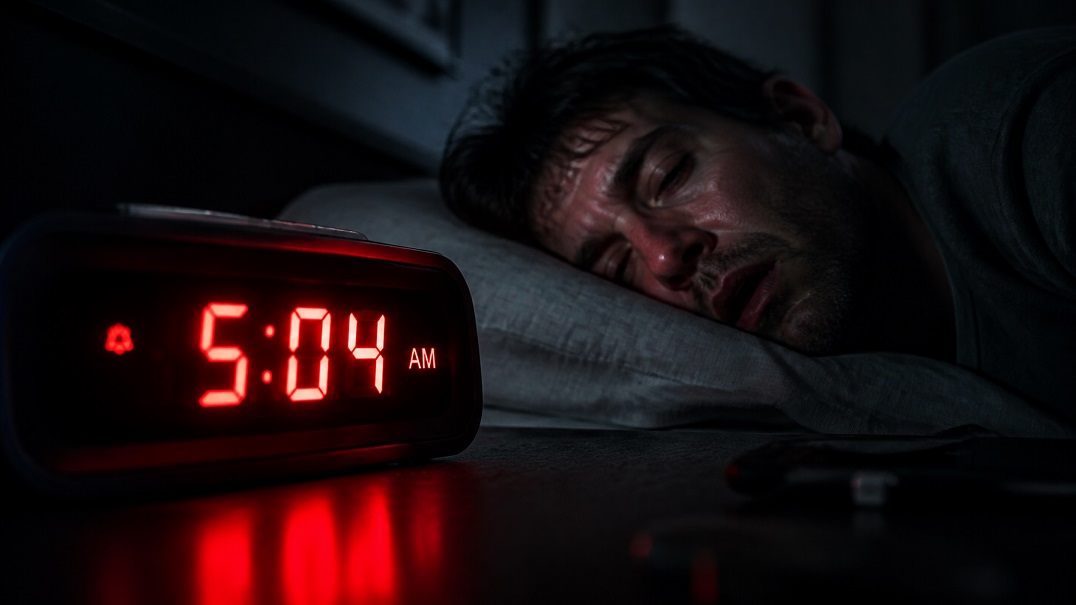
Sleep and testosterone are connected in both directions, and understanding both directions matters for breaking cycles that can otherwise persist indefinitely. Poor sleep suppresses testosterone — that much is covered extensively in our article on how sleep affects testosterone. What’s less often discussed is the reverse: testosterone affects sleep quality through its own mechanisms, and when testosterone falls, sleep frequently deteriorates alongside it. The two then suppress each other in a compounding loop that neither sleep hygiene alone nor testosterone treatment alone fully resolves.
This article focuses on the testosterone-to-sleep direction of the relationship — how testosterone influences sleep architecture, why hypogonadal men disproportionately experience poor sleep, and what the clinical research shows about the effects of testosterone treatment on sleep. It’s a companion piece to the lifestyle article and approaches the relationship from the hormonal health side rather than the sleep hygiene side.
For men who have tried improving their sleep through behavioral means — consistent schedules, light management, reducing alcohol — and still find their sleep quality poor, the hormonal contribution is worth examining. And for men being evaluated for low testosterone who haven’t been asked about their sleep quality, that’s a gap in the clinical picture worth filling in.
How Testosterone Influences Sleep Architecture
Sleep is not a uniform state. It cycles through distinct stages — light sleep, deep slow-wave sleep, and REM sleep — each of which has different physiological functions and different relationships with hormonal status. Testosterone doesn’t affect all sleep stages equally, and the way it shapes the architecture of the night has important implications for how restorative sleep actually is.
Testosterone and Slow-Wave Sleep
Slow-wave sleep — the deepest stage of non-REM sleep, sometimes called delta sleep or N3 — is when the most significant physical restoration occurs: growth hormone is released in its largest daily pulse, cellular repair processes are most active, and the immune system consolidates its responses. It’s also, not coincidentally, one of the sleep stages most sensitive to testosterone status.
Research using polysomnography — detailed overnight sleep recording that tracks brain wave activity and sleep stage cycling — has found that men with low testosterone spend less time in slow-wave sleep than hormonally normal men of comparable age. The relationship is not simply age-related; when testosterone status is controlled for, the effect of the hormone on slow-wave sleep duration is apparent. Studies that have acutely suppressed testosterone in healthy men — through GnRH agonist administration — show reductions in slow-wave sleep, while testosterone restoration in hypogonadal men tends to increase it.
The practical consequence of reduced slow-wave sleep is a night that’s less restorative than its duration suggests. A man sleeping seven hours with frequent slow-wave sleep disruption wakes less recovered than he should, and this subjective sense of unrefreshing sleep despite adequate hours is a common complaint in hypogonadal men that the sleep stage data helps explain.
Testosterone and REM Sleep
REM sleep — the stage most associated with dreaming, emotional memory consolidation, and cognitive processing — has a more complex relationship with testosterone. Testosterone levels naturally fluctuate across the night, with the highest levels occurring during the first REM episode and across subsequent REM cycles. The timing and completeness of REM sleep is both influenced by testosterone and is itself one of the periods during which testosterone is most actively produced. Disruptions to REM sleep therefore reduce testosterone production at the same time that the testosterone reduction that preceded them impairs the architecture supporting REM.
This cyclical relationship between REM sleep and testosterone production is one mechanism through which a single night of poor sleep can cascade into reduced testosterone the following day, and through which chronic sleep disruption produces the sustained testosterone suppression documented in research on sleep restriction.
Testosterone and Sleep Continuity
Beyond effects on specific sleep stages, low testosterone is associated with reduced sleep continuity — more nighttime awakenings, longer wake-after-sleep-onset times, and a more fragmented overall sleep pattern. Some of this fragmentation is secondary to other testosterone-associated conditions, particularly sleep apnea, which is discussed below. But some appears to reflect more direct effects of hormonal status on the neural systems that regulate sleep stability.
Men with low testosterone often describe their sleep as lighter, more easily interrupted, and less satisfying — independent of whether they have a formal sleep disorder. This subjective sense of diminished sleep quality maps onto what polysomnographic data shows about fragmentation and reduced deep sleep, and helps explain why addressing sleep hygiene without addressing the hormonal picture often produces incomplete improvement.
Sleep Apnea: The Testosterone-Sleep Intersection With the Highest Stakes
Obstructive sleep apnea (OSA) — the repeated partial or complete obstruction of the upper airway during sleep, producing oxygen desaturation and sleep fragmentation — sits at the intersection of the testosterone-sleep relationship in a way that deserves specific attention. The relationship between OSA and testosterone runs bidirectionally, involves significant health consequences, and is underdiagnosed in men in the relevant age range.
How OSA Suppresses Testosterone
Each apneic episode during sleep produces a brief oxygen desaturation, a cortisol spike as the body responds to the physiological stressor of airway obstruction, and a microarousal that fragments sleep architecture. In men with moderate to severe OSA, this pattern repeats dozens to hundreds of times per night. The cumulative effect on the hormonal environment is substantial: chronically elevated nocturnal cortisol suppresses testosterone through HPG axis interference; reduced slow-wave sleep impairs growth hormone and testosterone release; and the overall sleep fragmentation undermines the nocturnal hormonal production that accounts for most of a man’s daily testosterone.
Research consistently finds lower testosterone levels in men with untreated OSA compared to matched controls without sleep apnea. Studies measuring testosterone before and after CPAP treatment — the primary therapy for OSA — document testosterone increases following successful treatment, in some cases moving men from the deficient range into normal without any hormonal intervention. This makes OSA treatment one of the highest-leverage interventions available for testosterone in affected men, and makes screening for OSA essential in any man presenting with low testosterone and sleep complaints.
How Testosterone Influences OSA Risk
The relationship runs in the other direction as well. Testosterone affects upper airway muscle tone, body fat distribution, and central respiratory control — all of which influence OSA severity. Men have higher rates of OSA than premenopausal women partly because of the effects of testosterone on upper airway anatomy and fat distribution. Testosterone treatment in men with low testosterone can, in some cases, worsen OSA or unmask previously subclinical airway obstruction — which is why sleep apnea screening before and monitoring during TRT is considered standard practice.
This bidirectional relationship creates a clinical complexity: untreated OSA suppresses testosterone and justifies treatment; testosterone treatment can worsen OSA and require monitoring. The appropriate clinical response is to identify and treat OSA first, then reassess testosterone, while monitoring sleep disordered breathing in men who initiate TRT.
Testosterone Treatment and Sleep Quality: What the Research Shows
The research on testosterone treatment and sleep quality is smaller than might be expected given the clinical relevance of the question, but the available evidence provides useful direction.
Sleep Quality Improvements in Hypogonadal Men
Several studies have documented improvements in sleep quality following testosterone replacement in hypogonadal men without significant OSA. Improved scores on sleep quality questionnaires, reductions in nighttime awakening frequency, and increased slow-wave sleep duration have been reported in various study designs. Men on TRT frequently report improved sleep quality as one of the subjective benefits they notice — often alongside energy and mood improvements — though they may attribute it to other treatment effects rather than recognizing the direct hormonal influence on sleep architecture.
The subjective sleep improvement reported by men on TRT likely reflects multiple converging effects: improved slow-wave sleep from restored hormonal signaling, reduced nocturnal cortisol from the broader hormonal normalization, improvements in body composition that reduce upper airway fat deposition, and the general restorative effect of better hormonal health on the systems that regulate sleep. Disentangling which mechanism contributes most is methodologically difficult, and in clinical practice the combined effect is what matters.
Where Research Is More Cautious
Studies specifically examining sleep architecture using polysomnography in men on TRT have produced more mixed findings than subjective quality reports. Some show significant improvements in sleep stages; others show modest or no changes in sleep stage distribution despite subjective improvement. Part of this discrepancy may reflect the heterogeneity of the populations studied and the variability in baseline testosterone deficiency severity. The evidence is more consistent for subjective sleep quality improvement than for specific architectural changes, though this partly reflects the limitations of available research rather than an absence of architectural effects.
The most important caveat in the research is the OSA interaction. Studies that haven’t screened for and controlled OSA produce noisier findings because OSA simultaneously suppresses testosterone and impairs sleep in ways that confound the hormonal-sleep relationship. Research that has controlled for OSA more carefully tends to show more consistent sleep quality improvements with testosterone treatment.
The Compounding Loop and How to Break It
The testosterone-sleep bidirectional relationship creates a compounding loop that can be difficult to break when both sides are significantly impaired. Low testosterone impairs sleep quality; poor sleep suppresses testosterone further; reduced testosterone impairs sleep quality further; the cycle deepens. Men caught in this loop often find that behavioral sleep interventions produce partial and frustrating improvement because they’re working against a hormonal headwind, and that testosterone treatment alone produces incomplete improvement because the sleep disruption continues to suppress hormone levels.
Breaking the loop requires addressing both sides simultaneously or in the right sequence. For men with significant OSA, treating the sleep apnea first — because it’s both the more urgent medical condition and the intervention most likely to meaningfully raise testosterone without hormonal treatment — is the appropriate starting point. For men without OSA whose sleep quality is impaired and testosterone is low, simultaneous attention to both — behavioral sleep optimization alongside hormonal evaluation and treatment if warranted — tends to produce better outcomes than sequential approaches.
The lifestyle interventions that support testosterone also tend to support sleep through overlapping mechanisms. Regular exercise improves both sleep quality and testosterone. Stress management reduces cortisol, which benefits both the hormonal environment and sleep architecture. Body composition improvement reduces OSA severity and aromatase-driven testosterone suppression simultaneously. These shared mechanisms mean that comprehensive lifestyle improvement addresses both sides of the loop, which is one reason men who make multiple simultaneous lifestyle changes often report more robust overall improvement than those who change one variable at a time.
Questions Men Ask About Testosterone and Sleep Quality
Can low testosterone cause insomnia?
Low testosterone doesn’t typically cause classical insomnia — the persistent difficulty falling asleep that characterizes that condition — but it does impair sleep quality in ways that can present similarly. Reduced slow-wave sleep, increased nighttime awakening, and lighter, more fragmented sleep are the more characteristic testosterone-related sleep disruptions. Some men with low testosterone do report difficulty staying asleep, which is consistent with this fragmentation picture. The distinction matters for treatment: behavioral insomnia treatment (cognitive behavioral therapy for insomnia, or CBT-I) addresses sleep initiation and maintenance through different mechanisms than hormonal treatment, and the two may be complementary in men whose sleep problems have both components.
Should I get a sleep study before starting TRT?
Many physicians recommend OSA screening before initiating TRT, and there’s good clinical reasoning for this. If undiagnosed OSA is significantly suppressing testosterone, treating the apnea may normalize testosterone without requiring exogenous treatment. And since TRT can worsen OSA in some men, knowing the baseline respiratory status before starting treatment allows appropriate monitoring and early intervention if apnea develops or worsens. The threshold for recommending a formal sleep study varies by clinical context — men with symptoms suggesting OSA (loud snoring, witnessed apneas, daytime somnolence despite adequate sleep time) should be screened before TRT; men without those symptoms may not require formal evaluation before initiating treatment, though the question is worth raising with your physician. Our article on how to get a TRT prescription covers what the clinical evaluation process typically involves.
Yes, and this is one of the most characteristic presentations of testosterone-related sleep disruption. Time in bed doesn’t equal restorative sleep, and low testosterone impairs the quality of sleep stages rather than sleep duration. A man with low testosterone sleeping eight hours may spend less time in slow-wave sleep, experience more nighttime awakenings, and cycle through sleep stages less completely than a hormonally normal man — producing a night that feels subjectively inadequate despite adequate hours. If you consistently feel unrefreshed after what should be sufficient sleep, the quality of your sleep architecture is worth investigating alongside your testosterone levels.
Does testosterone replacement always improve sleep?
Not always, and not uniformly. Men with significant OSA who initiate TRT without treating the sleep apnea may see worsened sleep quality if the testosterone exacerbates airway obstruction. Men whose poor sleep has significant behavioral or psychological components — high pre-sleep anxiety, irregular schedules, poor sleep hygiene — may see incomplete improvement from hormonal treatment alone. And men with depression, which impairs sleep through its own mechanisms, may need both hormonal and mental health treatment for meaningful sleep improvement. Testosterone treatment improves sleep most reliably in men whose sleep disruption is primarily hormonal in nature and who don’t have significant confounding conditions.
How long after starting TRT does sleep quality improve?
Sleep quality improvements, when they occur, are often reported among the earlier subjective changes on TRT — sometimes within the first four to six weeks of treatment, as testosterone levels rise and begin normalizing the hormonal environment that influences sleep architecture. This timeline is consistent with the relatively rapid effects of testosterone on nocturnal cortisol dynamics and on the sleep stage distribution. Full sleep quality improvement may continue to develop over three to six months as testosterone reaches stable therapeutic levels and secondary effects — on body composition, mood, and energy — accumulate. Individual response varies, and men who also make concurrent sleep hygiene improvements tend to see better and faster results than those relying on hormonal treatment alone.
Can improving sleep naturally raise testosterone enough to make a meaningful difference?
For men whose testosterone is primarily suppressed by poor sleep rather than by primary hormonal dysfunction, yes — meaningfully so. The research on sleep restriction and testosterone recovery is clear: restoring sleep duration and quality in men who have been sleeping inadequately produces testosterone increases that are rapid (within one to two weeks) and meaningful in magnitude (10 to 15 percent or more). For men with sleep apnea, treating it can produce testosterone improvements comparable to some pharmacological interventions. For men with good sleep who still have low testosterone, sleep improvement alone won’t move the needle as significantly — because the hormonal suppression from poor sleep isn’t the primary driver. The impact of sleep improvement on testosterone is proportional to how much sleep quality was contributing to the suppression in the first place.