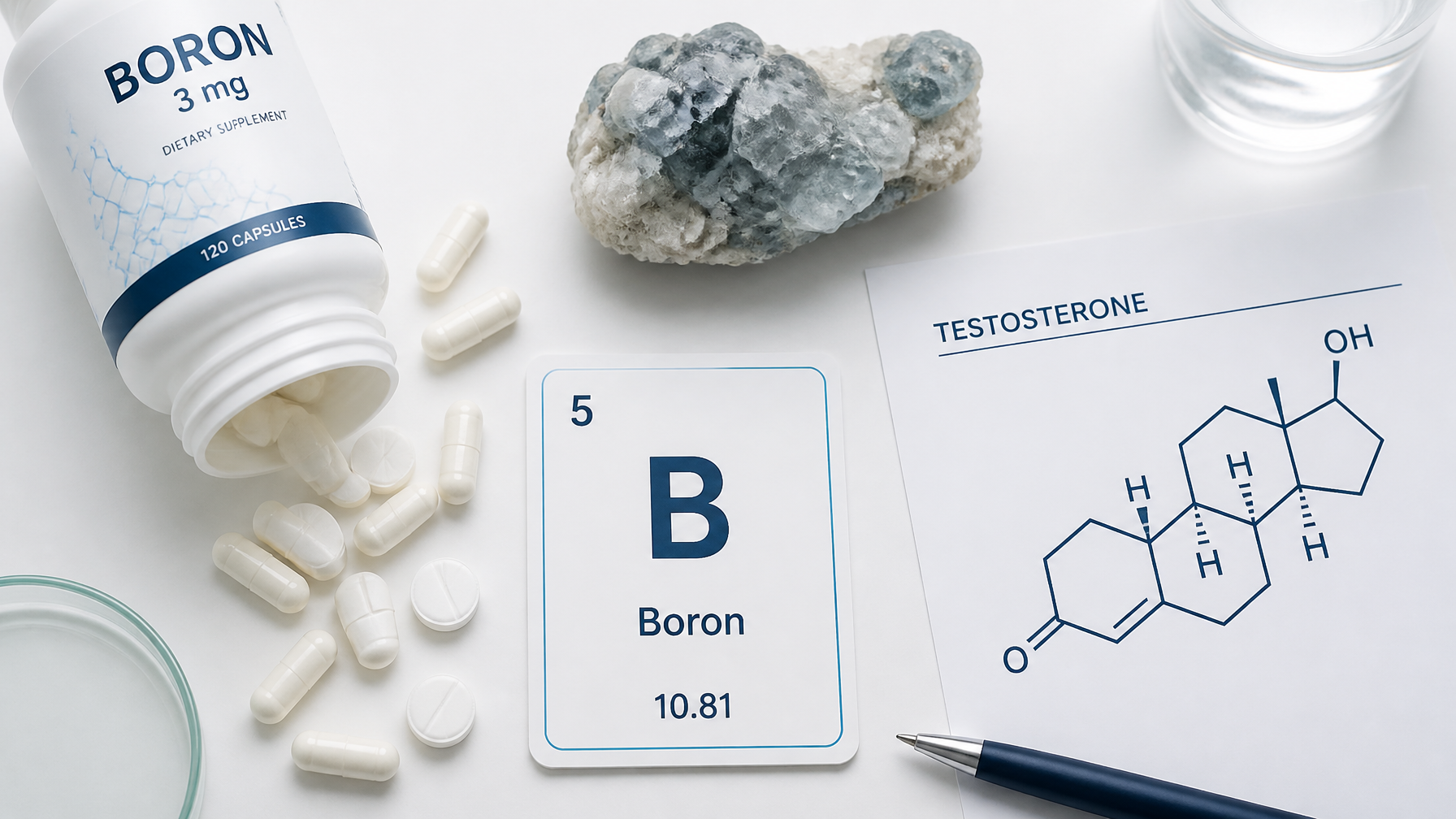
Boron doesn’t have the cultural cachet of ashwagandha or the name recognition of zinc. It rarely appears in headlines about testosterone, and most men who take multi-ingredient testosterone boosters have consumed it without knowing it was there. That relative obscurity is undeserved. Boron is a trace mineral with a small but genuinely interesting body of research behind its effects on testosterone — and the specific mechanism it appears to work through is distinct enough from other ingredients in this category to make it worth understanding on its own terms.
Boron is an ultratrace mineral, meaning the body requires it in very small amounts — milligrams rather than the hundreds of milligrams needed for zinc and magnesium. It’s found in plant foods, particularly fruits, vegetables, legumes, and nuts, and is not typically considered a mineral for which deficiency is common in men with varied diets. Despite this, supplementation studies at doses higher than typical dietary intake have produced hormonal effects that are specific, measurable, and mechanistically coherent.
This article examines what boron does in the body, how it appears to influence testosterone and related hormones, what the research shows, and whether it represents a meaningful addition to a natural testosterone support strategy.
How Boron Is Thought to Influence Testosterone
Boron’s proposed mechanisms for supporting testosterone are distinct from those of the other minerals covered in this category. It doesn’t appear to stimulate testosterone production directly, nor does it function primarily as an enzymatic cofactor the way zinc does. Its most documented effects involve the metabolism and distribution of both testosterone and estrogen — and the relationship between the two.
Boron and SHBG Reduction
The most consistently documented effect of boron supplementation in human studies is a reduction in sex hormone-binding globulin (SHBG). As covered in Free vs. Total Testosterone: What’s the Difference?, SHBG binds testosterone in the bloodstream and renders it unavailable to cells and tissues. A reduction in SHBG — without any change in total testosterone production — increases the free fraction and therefore increases the amount of testosterone available to produce effects in the body.
Several boron supplementation studies have found meaningful reductions in SHBG alongside increases in free testosterone, without correspondingly large increases in total testosterone. This pattern is consistent with a primary mechanism of SHBG modulation rather than production stimulation — the same pattern observed with Tongkat Ali and, to some extent, magnesium. For men whose primary testosterone issue involves high SHBG reducing free testosterone availability, this mechanism is directly relevant.
Boron and Estrogen Metabolism
Boron appears to influence estrogen metabolism in ways that affect the testosterone-to-estrogen ratio. Specifically, some research has found that boron supplementation reduces levels of estradiol — the primary estrogen in men — while simultaneously increasing free testosterone. This dual effect shifts the hormonal balance in a favorable direction without requiring any change in total testosterone production.
The proposed mechanism involves boron’s influence on the enzymes responsible for estrogen synthesis and metabolism, though the precise pathway is not as clearly established as the SHBG effect. What the research does show consistently is the directional outcome: in men supplementing boron, free testosterone tends to rise and estradiol tends to fall, which is the hormonal shift that most men with suboptimal testosterone ratios are looking for.
Boron and Vitamin D Activation
A potentially important but less fully explored mechanism involves boron’s relationship with vitamin D metabolism. Research has found that boron influences the conversion of vitamin D to its active form — calcitriol — and that boron supplementation increases circulating levels of active vitamin D. Given vitamin D’s well-documented role in testosterone production (covered in Vitamin D and Testosterone: What the Research Says), boron’s capacity to enhance vitamin D activation provides an indirect pathway through which it might support testosterone — particularly relevant for men whose vitamin D levels are marginal rather than severely deficient.
This mechanism also suggests that boron’s effects may be amplified in men who are simultaneously addressing their vitamin D status, since the two nutrients interact in a way that makes their combined adequacy more important than either alone.
What the Clinical Research Shows
The research base for boron and testosterone is smaller than for ashwagandha or vitamin D — there are fewer studies, and they tend to be shorter and involve smaller numbers of participants. What exists is nonetheless consistent enough to be informative.
The Naghii Study: A Foundational Finding
A frequently cited study by Naghii and colleagues, published in the Journal of Trace Elements in Medicine and Biology, examined the effects of 10 mg of boron daily for one week in healthy male volunteers. The results were notable for their specificity: free testosterone increased by approximately 28 percent from baseline, total testosterone showed a modest non-significant increase, estradiol decreased significantly, and SHBG showed a downward trend. Inflammatory markers also improved.
The magnitude of the free testosterone increase — 28 percent in a single week at a relatively modest dose — is striking for any natural supplement study, and it aligns with the SHBG and estrogen metabolism mechanisms described above. A reduction in SHBG frees more of the total testosterone into the free fraction, which would produce exactly this kind of disproportionate increase in free versus total testosterone.
The short duration of the study is a limitation — one week provides no information about whether effects are sustained over months, whether they plateau, or whether any adaptation occurs over longer supplementation periods. But as an initial proof-of-concept study, the directional findings are clear and mechanistically coherent.
Supporting Evidence From Dietary and Epidemiological Research
Beyond direct supplementation studies, several lines of epidemiological and dietary research support the relationship between boron and male hormonal health. Studies examining dietary boron intake and hormonal outcomes have found associations between higher boron consumption and more favorable testosterone-to-estrogen ratios. Research in populations with naturally high dietary boron intake — associated with diets rich in fruits, vegetables, and legumes — has found lower rates of certain hormone-related conditions compared to populations with lower boron intake.
These associations are observational and do not establish causation, but they are consistent with the mechanistic and supplementation evidence and contribute to a coherent overall picture.
Boron and Inflammatory Markers
Several boron studies have found reductions in inflammatory markers — particularly C-reactive protein (CRP) and certain cytokines — alongside the hormonal effects. This is worth noting because chronic low-grade inflammation is independently associated with lower testosterone and with the suppression of the hypothalamic-pituitary-gonadal axis. Whether boron’s anti-inflammatory effects contribute to its testosterone-supporting effects, or whether these are parallel independent effects, is not fully established — but the anti-inflammatory dimension adds to the overall picture of boron as an ingredient with broader physiological relevance than a simple hormone supplement framing would suggest.
What the Research Does Not Establish
The limitations of the boron research are worth stating clearly. The studies are generally small and short. Long-term supplementation data is limited. Most studies used doses of 6 to 10 mg daily — above typical dietary intake but not dramatically so — and the effects at lower or higher doses are not well-characterized. And the research has not been replicated as extensively as the evidence for vitamin D, zinc, or ashwagandha, which means the findings should be held with somewhat more uncertainty than for those better-studied ingredients.
Dietary Sources and Typical Intake
Boron is found predominantly in plant foods. Fruits — particularly apples, pears, grapes, and dried fruits — are among the richest sources. Nuts and legumes provide meaningful amounts. Vegetables, particularly avocados and broccoli, contribute as well. Coffee and wine also contain boron in amounts that can meaningfully affect daily intake.
Estimated typical dietary intake of boron in Western populations ranges from approximately 1 to 3 mg per day, with higher intakes in men whose diets include significant amounts of fruits, nuts, and legumes. The supplementation doses used in clinical studies — typically 6 to 10 mg per day — represent a two-to-fivefold increase above typical dietary intake rather than the correction of a frank deficiency.
This is a meaningful distinction from zinc, magnesium, and vitamin D, where the primary research-supported benefit involves correcting widespread deficiency. With boron, the benefit appears to operate even in men who are not deficient — the supplementation dose is above dietary levels regardless of how varied the diet is, and the effects observed in studies reflect pharmacological augmentation rather than deficiency correction. This makes boron mechanistically different from the essential mineral micronutrients and somewhat closer in character to the herbal ingredients earlier in this category.
Dosage and Safety
Clinical studies examining boron’s effects on testosterone have primarily used doses of 6 to 10 mg per day. The Naghii study used 10 mg daily; other studies have used 6 mg. These doses represent the range for which there is direct human evidence of hormonal effects, and they are within the tolerable upper intake level established for boron.
Safety Considerations
The tolerable upper intake level for boron established by the Institute of Medicine is 20 mg per day for adults. This provides meaningful headroom above the 6 to 10 mg doses used in testosterone research, suggesting that supplementation at these levels is not approaching toxicity thresholds for most healthy adults.
At very high doses — well above supplementation ranges — boron can cause reproductive toxicity in animal models, which contributed to early concerns about its safety. At the doses relevant for testosterone support (6 to 10 mg), no such effects have been observed in human studies, and the ingredient is generally regarded as safe within this range. Men with kidney disease should exercise caution, as boron is excreted renally and impaired kidney function could allow accumulation.
Using Boron as a Standalone Supplement
Boron is available in several supplement forms, with boron glycinate and boron citrate among the most commonly encountered. It is typically sold in capsule or tablet form rather than as a powder, given the small doses involved — measuring milligrams of powder accurately without a precise scale is impractical for most home supplementers.
BulkSupplements.com carries boron in capsule form, providing a cost-effective standalone option for men who want to include it as a targeted addition to their supplementation routine without committing to a multi-ingredient product. Given the small effective dose — 6 to 10 mg — boron supplementation is one of the least expensive per-serving additions in the natural ingredients category.
Boron is generally well-tolerated at the doses used in clinical research, with no significant side effects reported in human studies at 6 to 10 mg daily. Taking it with food is a reasonable practice, though it is less critical than for minerals like zinc and magnesium that are more likely to cause gastrointestinal effects on an empty stomach.
Where Boron Fits in a Natural Testosterone Strategy
Boron occupies an interesting position among the natural ingredients covered in this category. It’s not a foundational nutritional prerequisite in the way that zinc, magnesium, and vitamin D are — men with adequate diets are not typically deficient in boron. But it does appear to produce hormonal effects at supplementation doses, particularly on SHBG and estradiol, that are distinct from any of the other ingredients discussed here.
For men who have addressed their nutritional foundations — vitamin D status, zinc adequacy, magnesium intake — and are looking for additional natural support, boron represents a low-cost, well-tolerated addition with a coherent mechanism and consistent directional evidence. Its primary value is likely in the free testosterone space: men whose total testosterone is adequate but whose free testosterone is lower than optimal due to elevated SHBG may find boron’s SHBG-reducing effect particularly relevant.
It also pairs logically with vitamin D supplementation, given their interaction in vitamin D activation — making it a natural companion to the vitamin D recommendation made in Vitamin D and Testosterone: What the Research Says. And for men looking at multi-ingredient testosterone boosters, The Most Important Ingredients in Any Testosterone Booster discusses how boron fits into the broader formulation landscape.
Questions Men Ask About Boron and Testosterone
Does Boron Actually Increase Testosterone?
The most consistent finding in boron supplementation research is an increase in free testosterone rather than total testosterone, alongside reductions in SHBG and estradiol. A well-designed study found a 28 percent increase in free testosterone after just one week of supplementation at 10 mg daily. The mechanism — SHBG reduction freeing more bound testosterone — is coherent and consistent with the observed outcomes. The research base is smaller than for some other ingredients in this category, but the directional evidence is consistent and the mechanism is well-established.
How Much Boron Should I Take for Testosterone Support?
Clinical studies examining testosterone-related outcomes have primarily used 6 to 10 mg of boron daily. This range is well below the tolerable upper intake level of 20 mg per day and appears both effective and safe in the available human research. Most boron supplements are formulated in doses within this range. There is no established reason to exceed 10 mg daily for testosterone support purposes, and doses above the tolerable upper intake level should be avoided.
Can I Get Enough Boron From Food?
Typical dietary boron intake in Western populations is approximately 1 to 3 mg per day from foods including fruits, nuts, legumes, and vegetables. The supplementation doses shown to produce hormonal effects in clinical research — 6 to 10 mg per day — are above what diet alone typically provides, meaning supplementation represents augmentation above dietary intake rather than correction of deficiency. Men with particularly high consumption of fruits, nuts, and legumes may have dietary intakes closer to 3 to 4 mg per day, but still below the research doses.
How Quickly Does Boron Work?
The most detailed short-term supplementation study found significant changes in free testosterone and estradiol within one week of daily supplementation at 10 mg. This is faster than most natural ingredients in this category, where effects typically take four to twelve weeks to become apparent. Whether the initial changes seen at one week are representative of longer-term effects, or whether they plateau or change in character over months of supplementation, is not well-characterized in the available research.
Does Boron Interact With Other Supplements?
The most notable interaction is with vitamin D. Boron appears to enhance the conversion of vitamin D to its active form, which means men supplementing both may experience amplified vitamin D effects — generally a positive interaction, but worth being aware of when adjusting doses of either nutrient. No significant negative interactions between boron and other common testosterone-supporting supplements have been documented in the available research. As with any supplement addition, men on prescription medications should mention new supplements to their physician.
Is Boron Worth Adding if I’m Already Taking Zinc, Magnesium, and Vitamin D?
It may be, depending on your specific hormonal picture. If your primary concern is low free testosterone despite adequate total testosterone — a pattern consistent with elevated SHBG — boron’s SHBG-reducing mechanism addresses the issue more directly than zinc, magnesium, or vitamin D do. If your concerns are more broadly about total testosterone production and nutritional deficiency, getting the three foundational nutrients right takes priority. Boron is best understood as a targeted addition for men who have addressed their nutritional foundations and are looking for additional support for the SHBG and estrogen balance side of the equation.