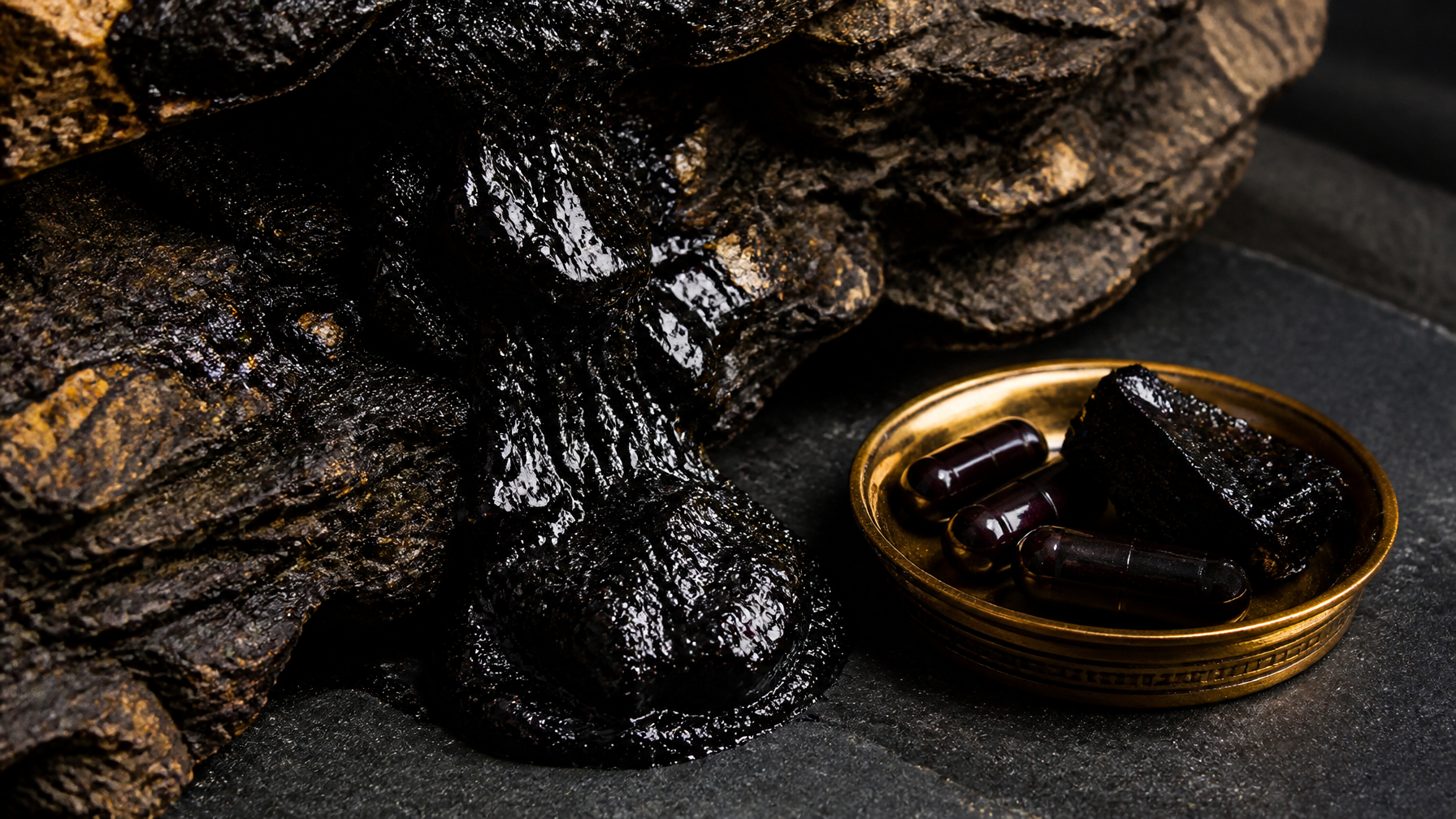
Shilajit is one of the more unusual substances covered in this category — unusual in its origins, in its composition, and in the way its traditional reputation has been investigated by modern science. It doesn’t fit neatly into the categories of herb, mineral, or vitamin that describe most natural ingredients. It is, in essence, a complex organic substance that forms over centuries from the decomposition of plant matter compressed between rock layers in high-altitude mountain ranges, primarily the Himalayas, Altai, and Caucasus. The result is a dark, resinous material that has been used in Ayurvedic medicine for millennia and that contains an extraordinarily diverse mixture of organic acids, minerals, and bioactive compounds.
That unusual origin has made shilajit difficult to study in the standardized way that single-compound supplements are studied. The composition varies by geographic source, altitude, and processing method. The active compounds are multiple and interact in ways that single-ingredient research can’t fully capture. And the research base, while growing, is smaller and more variable than for the better-studied ingredients in this category.
Despite these complexities, the clinical research that does exist on shilajit and testosterone is among the more interesting in the natural ingredients category — consistent in direction, mechanistically coherent, and supported by a plausible biological rationale. This article examines what shilajit is, what the research shows, and where it fits in a natural approach to testosterone support.
What Shilajit Is and What It Contains
Understanding shilajit’s effects requires some familiarity with its composition, because the mechanism through which it influences testosterone is tied to its unique chemical profile rather than to a single dominant bioactive compound.
Fulvic Acid: The Primary Active Component
The compound most consistently associated with shilajit’s biological effects is fulvic acid — a complex organic acid produced by microbial decomposition of plant material that makes up a significant proportion of quality shilajit products, typically 15 to 50 percent by weight depending on the source and processing. Fulvic acid has several properties relevant to health: it acts as a carrier molecule that enhances the cellular uptake of minerals and other nutrients, it has antioxidant activity, and it appears to influence mitochondrial function in ways that affect cellular energy production.
The mitochondrial connection is particularly relevant to shilajit’s effects on testosterone. Testosterone synthesis in Leydig cells is an energy-intensive process that depends on mitochondrial function, and fulvic acid’s capacity to support mitochondrial activity — specifically through its effects on CoQ10 recycling and electron transport chain function — provides a plausible mechanism for supporting the energy supply that testosterone production requires.
Dibenzo-alpha-pyrones and Other Compounds
Beyond fulvic acid, shilajit contains dibenzo-alpha-pyrones (DBPs) and their derivatives — compounds that appear to work synergistically with fulvic acid in supporting mitochondrial function. It also contains humic acids, trace minerals in organic form, and various plant-derived metabolites whose individual contributions to shilajit’s overall effects are not fully characterized.
This complexity — a substance with dozens of bioactive components rather than one or two — is both what makes shilajit scientifically interesting and what makes it difficult to study in the same way as simpler ingredients. It also raises meaningful questions about product quality: a shilajit product that has been poorly sourced, inadequately processed, or heavily diluted may contain very different amounts of active compounds than one that has been properly purified and standardized.
How Shilajit Is Thought to Influence Testosterone
The proposed mechanisms for shilajit’s testosterone-supporting effects are distinct from those of any other ingredient covered in this category, which is part of what makes it worth examining seriously rather than dismissing as an exotic marketing ingredient.
Mitochondrial Support and Leydig Cell Function
The primary proposed mechanism connects shilajit’s mitochondrial effects to testosterone production at the cellular level. Leydig cells require significant mitochondrial activity to synthesize testosterone — the conversion of cholesterol to testosterone precursors is an energy-dependent process that occurs within mitochondria. Fulvic acid and the DBP compounds in shilajit appear to support the efficiency of the mitochondrial electron transport chain, potentially improving the energy supply available for steroidogenesis.
This mechanism is conceptually similar to the role that CoQ10 plays in general mitochondrial support, and indeed some research has examined shilajit’s interaction with CoQ10 specifically — finding that shilajit enhances CoQ10’s bioavailability and mitochondrial effects. The practical implication is that shilajit may support testosterone production by improving the energetic efficiency of the cells responsible for making it, rather than by stimulating the hormonal signaling chain or modulating SHBG.
Gonadotropin Support
Some animal research has found that shilajit influences FSH and LH secretion — the pituitary hormones that drive testicular function. If this effect translates meaningfully to humans, it would add an upstream signaling component to shilajit’s testosterone-supporting profile, complementing the direct mitochondrial mechanism. The human evidence for this pathway is less developed than the animal research, which means it should be held as a plausible additional mechanism rather than an established finding.
Testosterone Precursor Support
Shilajit contains minerals in organic, highly bioavailable forms — including zinc, which plays a direct role in testosterone synthesis as discussed in Zinc and Testosterone: What the Research Says. While the amounts of zinc in shilajit are not sufficient to replace standalone zinc supplementation, they contribute to the overall mineral environment in which testosterone is produced. The organic mineral forms in shilajit may also be more bioavailable than the inorganic mineral salts found in most supplements, adding a quality dimension to this contribution.
What the Clinical Research Shows
The research base for shilajit and testosterone in humans is smaller than for ashwagandha, vitamin D, or zinc, but what exists is consistently positive in direction and methodologically reasonable for a compound this complex to study.
The Primary Human Testosterone Study
The most frequently cited human study examining shilajit’s effects on testosterone was published in Andrologia in 2016. It enrolled 75 healthy male volunteers aged 45 to 55 — a population representative of men in the age range where testosterone decline becomes clinically relevant — and randomized them to receive either 250 mg of purified shilajit twice daily (500 mg total) or a placebo for 90 days.
The results were notably consistent across multiple hormonal measures. Men receiving shilajit showed significant increases in total testosterone (approximately 20 percent above baseline), free testosterone (approximately 19 percent above baseline), and DHEA-S compared to placebo. Gonadotropin levels also showed favorable trends, consistent with the upstream signaling mechanism proposed in the animal research. The effect sizes are meaningful — a 20 percent increase in total testosterone over 90 days in middle-aged men is a clinically relevant change — and the population studied closely matches the demographic most likely to benefit from natural testosterone support.
The 90-day duration is longer than many supplement studies in this category, which adds confidence that the observed effects represent sustained support rather than a short-term perturbation. The use of purified shilajit standardized to fulvic acid content is also methodologically appropriate, addressing the product quality variability that complicates shilajit research generally.
Studies on Physical Performance and Fatigue
Beyond the direct testosterone study, shilajit has been examined for effects on physical performance, fatigue, and muscle function — outcomes directly relevant to men experiencing age-related hormonal decline. A study published in the Journal of the International Society of Sports Nutrition found that shilajit supplementation at 500 mg daily for eight weeks preserved muscle strength and reduced fatigue markers in physically active men following a fatiguing exercise protocol, compared to placebo.
These findings are consistent with the mitochondrial mechanism — improved cellular energy production supporting physical function — and add to the picture of shilajit as an ingredient with broader effects on male vitality than a simple hormone number would capture.
Research on Spermatogenic Function
Several studies have examined shilajit’s effects in men with fertility-related concerns, finding improvements in sperm count, motility, and testosterone alongside improvements in FSH and LH. While these populations differ from healthy men experiencing age-related decline, the consistency of the testosterone improvements across fertility and non-fertility populations strengthens the overall case for a genuine hormonal effect rather than a population-specific artifact.
What the Research Does Not Establish
The limitations are real and worth stating clearly. The total number of human clinical trials examining shilajit and testosterone is small — the primary testosterone study involved 75 men over 90 days, which is meaningful but not definitive. Most research has used specific purified preparations rather than the varied commercial products available to consumers. Long-term safety data beyond 90 days is limited. And the mechanisms proposed — while biologically plausible — are not as thoroughly characterized in human physiology as those for simpler, better-studied ingredients.
Product Quality: A Critical Consideration for Shilajit
Shilajit is an area where product quality concerns are more significant than for any other ingredient in this category, and those concerns deserve explicit attention rather than a brief mention.
The Heavy Metal Contamination Issue
Raw shilajit from mountain sources can contain heavy metals — including lead, arsenic, and mercury — that are present in the rock formations from which it is extracted. This is not hypothetical: several analyses of commercially available shilajit products have found heavy metal levels above safe thresholds in unpurified or inadequately processed products. This is a genuine safety concern, not a theoretical one.
Properly purified shilajit, processed to remove heavy metals while preserving the active fulvic acid and DBP compounds, is a different product from raw or minimally processed shilajit. When selecting a shilajit supplement, looking for products that have been third-party tested for heavy metals and that specify their purification process is not optional — it is a basic safety requirement for this specific ingredient.
Standardization to Fulvic Acid Content
Given that fulvic acid is the primary characterized active component, products standardized to a specified fulvic acid percentage provide more reliable and consistent dosing than unstandardized shilajit resin or powder. Most quality shilajit supplements specify fulvic acid content of 50 percent or above. The clinical study that found significant testosterone improvements used purified shilajit standardized to fulvic acid content — which is the appropriate reference point for product selection.
Dosage and Form
The primary human testosterone study used 250 mg of purified shilajit twice daily — 500 mg total per day. This aligns with the dose range used in most human research and represents the most directly supported dosing approach for testosterone-related outcomes. Some products are formulated at 200 to 250 mg once daily, which is below the research dose; twice-daily dosing at 250 mg per dose more closely mirrors the study protocol.
Shilajit is available in resin, powder, and capsule forms. The resin form — a thick, tar-like substance that is dissolved in warm water or under the tongue — is considered the most natural and least processed form, though standardization of active compound content is harder to verify in resin products. Capsules containing standardized purified shilajit extract are more practical for consistent daily dosing and easier to evaluate for quality based on label information.
Shilajit is generally well-tolerated at research doses. It should be avoided by men with gout, as it may increase uric acid levels. Men with iron overload conditions should also use caution, as shilajit’s fulvic acid can enhance iron absorption. As noted above, product selection with attention to heavy metal testing is particularly important for this ingredient.
Where Shilajit Fits in a Natural Testosterone Strategy
Shilajit’s mitochondrial mechanism is genuinely distinct from every other ingredient covered in this category. Where zinc and magnesium provide mineral cofactors for enzymatic pathways, vitamin D acts as a hormonal regulator, ashwagandha reduces cortisol, Tongkat Ali and boron modulate SHBG, fenugreek inhibits conversion enzymes, and D-aspartic acid stimulates upstream signaling — shilajit appears to support the cellular energy infrastructure that all of these pathways ultimately depend on.
That position in the mechanism landscape makes it a genuinely complementary addition rather than a redundant one, for men who have addressed their nutritional foundations and are looking for broader support. Its documented effects in the 45 to 55 age range — the demographic most likely to be experiencing the gradual testosterone decline this site addresses — are particularly relevant.
For men evaluating the full landscape of natural testosterone support, the other articles in the Natural Ingredients category provide context for how shilajit relates to each of the other ingredients. And for men considering multi-ingredient testosterone boosters that include shilajit, The Most Important Ingredients in Any Testosterone Booster provides a framework for assessing whether the included dose and form represent meaningful quantities of this complex ingredient.
Questions Men Ask About Shilajit and Testosterone
Does Shilajit Actually Increase Testosterone?
The primary human clinical trial found significant increases in both total and free testosterone — approximately 20 percent above baseline — in men aged 45 to 55 over 90 days of supplementation with purified shilajit. This is among the more impressive findings in the natural ingredients category for that age group. The research base is smaller than for ashwagandha or vitamin D, but the results from the available studies are consistent in direction and the mechanism is biologically coherent.
What Makes Shilajit Different From Other Natural Testosterone Ingredients?
Its mechanism is unique among the ingredients covered in this category. Rather than modulating SHBG, inhibiting conversion enzymes, reducing cortisol, or providing mineral cofactors, shilajit’s primary proposed mechanism involves supporting mitochondrial function in the Leydig cells responsible for testosterone synthesis — improving the cellular energy supply that steroidogenesis depends on. This is a genuinely distinct pathway that complements rather than duplicates the mechanisms of other natural testosterone-supporting ingredients.
Is Shilajit Safe to Take?
Properly purified shilajit that has been tested for heavy metals and processed to remove contaminants is generally considered safe at research doses. The safety concern specific to shilajit is heavy metal contamination in raw or inadequately processed products — a real risk that makes product selection particularly important for this ingredient. Men with gout should avoid shilajit due to potential effects on uric acid levels. Men with iron overload conditions should use caution given fulvic acid’s capacity to enhance iron absorption.
How Do I Choose a Quality Shilajit Product?
Look for products that specify purification processes designed to remove heavy metals and that have been third-party tested for heavy metal content. Products standardized to a specified fulvic acid percentage — ideally 50 percent or above — provide more consistent dosing than unstandardized resins. Avoid products that don’t disclose their source, processing method, or active compound content. For this ingredient more than most, price is not a reliable guide to quality — cheap shilajit is more likely to be inadequately purified, which matters for safety as well as efficacy.
How Long Does Shilajit Take to Work?
The primary testosterone study ran for 90 days, which is longer than most supplement studies in this category. Some effects — particularly on energy and physical performance — may become noticeable within four to six weeks. Meaningful changes in testosterone levels, based on the research, appear to develop over two to three months of consistent daily supplementation. Shilajit is not an ingredient where short trial periods are likely to be informative — a minimum of 60 to 90 days is appropriate before evaluating results.
Can I Take Shilajit With Other Natural Testosterone Supplements?
Generally yes. Shilajit’s mechanism is distinct from that of all other natural ingredients commonly used for testosterone support, and no significant negative interactions with ashwagandha, Tongkat Ali, zinc, magnesium, vitamin D, or other ingredients in this category have been documented. Its capacity to enhance mineral absorption through fulvic acid is a positive interaction with mineral supplements in many cases. Men on prescription medications — particularly those affecting iron metabolism, uric acid levels, or kidney function — should discuss shilajit use with their physician before adding it.