
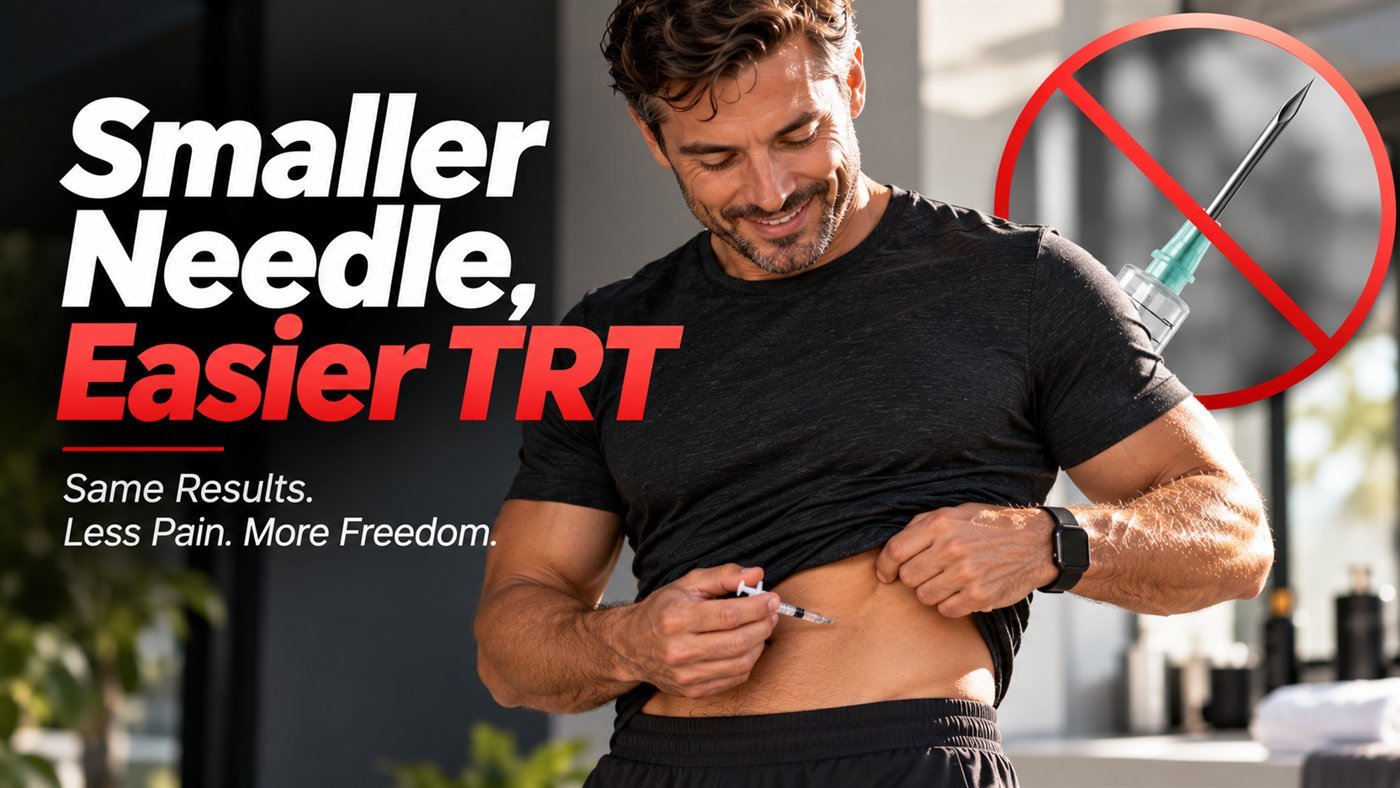
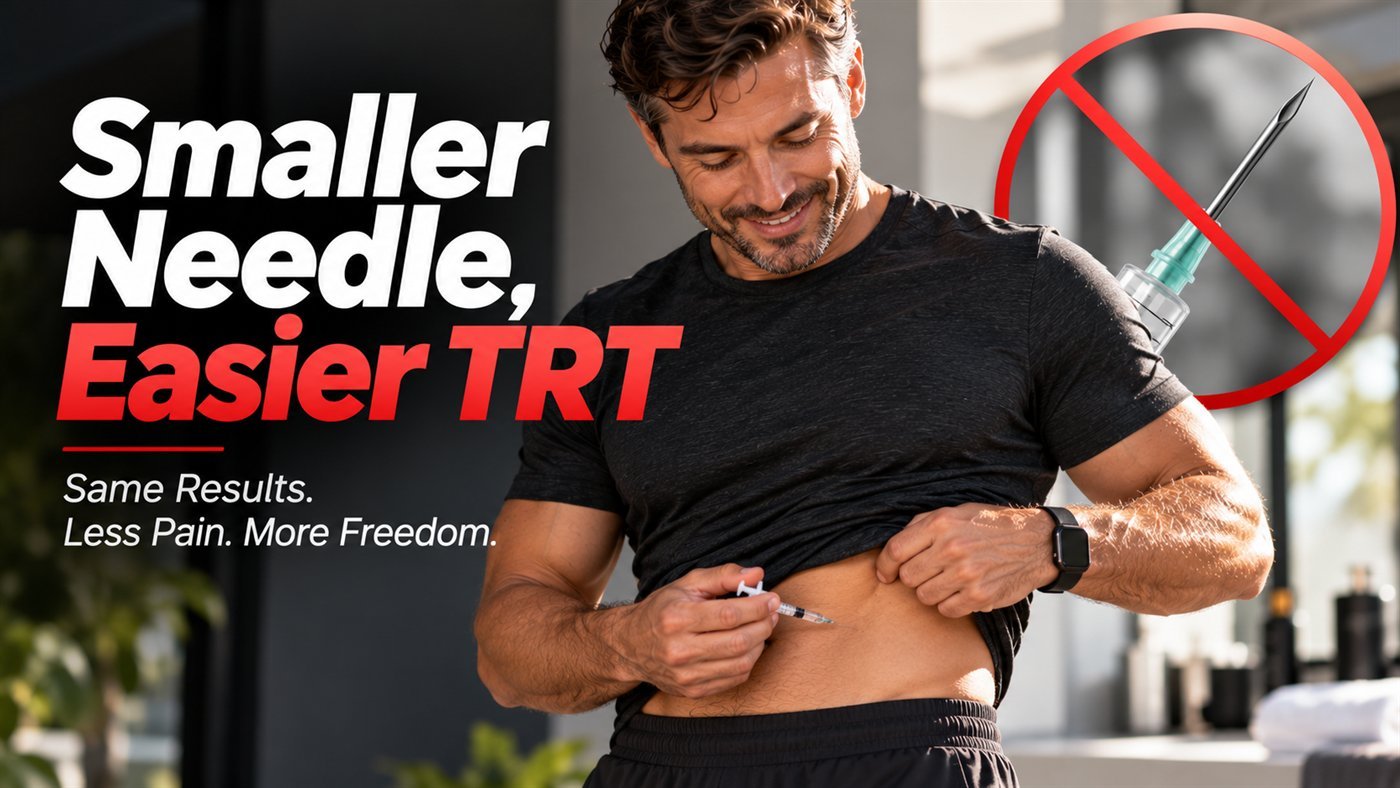
If you have ever pictured testosterone therapy as a long needle and a sore backside for three days afterward, you are picturing the way it was done for decades. It is not how we do it.
Most of our patients inject subcutaneously — into the fat layer just under the skin, using a small insulin-style needle — rather than deep into the muscle. Here is why we have made that our default, and what it means for how you actually feel week to week.
The problem with the old way
The traditional approach was a large intramuscular injection every two to three weeks. That schedule was built around convenience for the clinic, not around how the body actually handles testosterone.
What it produces is a roller coaster. Levels climb well above the normal range in the first few days after the shot, then fall steadily until, by the end of the interval, many men are back where they started — or lower. Patients describe it exactly the way you would expect: a good stretch in the first week, a fade in the second, and a rough final stretch of fatigue, low mood and flat motivation right before the next injection.
The dose was not wrong. The delivery was.
What changes with subcutaneous dosing
Fat tissue absorbs testosterone more slowly and more steadily than muscle does. Paired with smaller, more frequent doses — typically weekly or twice weekly rather than every few weeks — the result is a much flatter curve.
Published pharmacokinetic studies of subcutaneous testosterone have consistently shown lower peak concentrations and higher, more stable troughs compared with large intramuscular doses, while keeping total exposure in the same therapeutic range. An FDA-approved subcutaneous testosterone enanthate product was approved in 2018 on the strength of exactly this profile.
For you, the practical translation is:
- Fewer highs and lows. Less of the “great week, terrible week” pattern.
- More predictable energy and mood, rather than benefit that is front-loaded after each injection.
- Steadier bloodwork, which makes it far easier for your physician to interpret your labs and adjust your dose intelligently. When levels swing wildly, a single lab draw tells us very little about where you actually live day to day.
- Better control over side effects. Many of the issues men worry about with testosterone therapy — elevated red blood cell counts, estrogen-related symptoms, water retention — track more closely with the size of the peak than with the average level. Lowering the peak is one of the most useful tools we have.
Individual response varies, and not everyone experiences every one of these. That is part of why we monitor.
It genuinely hurts less
This is the part patients notice first.
Intramuscular injections use a longer, thicker needle and deposit a larger volume into muscle tissue, which is why post-injection soreness has been such a common complaint. Subcutaneous injections use a short, fine needle — the same kind used for insulin — inserted into the abdomen or thigh at a shallow angle. Most patients describe it as a brief pinch, and many report they stop noticing it altogether within a few weeks.
Smaller, more frequent doses also mean a smaller volume going in each time, which is itself a major driver of comfort. The technique is straightforward enough that most men are confident doing it themselves after one walkthrough, and we will take you through it step by step.
Why the carrier oil matters
Testosterone does not dissolve in water. It has to be suspended in an oil, and the oil your prescription is made with affects the experience more than most patients realize.
Older preparations typically used heavier seed oils — cottonseed, sesame or grapeseed. They work, but they are thick, which means slower absorption from the injection site and more resistance pushing through a fine needle.
We prefer MCT oil — medium-chain triglyceride oil, derived from coconut — as a carrier where it is available for the medication being prescribed:
- It is thinner. Lower viscosity means it passes easily through the small-gauge needles that make subcutaneous injection comfortable in the first place. With heavier oils, fine needles can be slow and difficult to push.
- It tends to cause less local irritation. Post-injection soreness, redness and lumps at the injection site are frequently a reaction to the carrier oil rather than to the testosterone itself. Patients switching from a seed oil preparation to MCT commonly report noticeably less irritation.
- It is a practical option for patients with seed oil sensitivities. Sesame allergy in particular is not rare, and cottonseed sensitivity does occur.
MCT oil does not make testosterone work better — the hormone is identical either way. What it changes is tolerability, and tolerability is what determines whether you actually stay consistent with therapy over months and years. Consistency is what produces results.
How we approach dosing
Our protocol is built around the same principle throughout: smaller doses, given more often, adjusted to you.
We start conservatively, recheck labs at defined intervals, and titrate based on both your numbers and your symptoms — because the two do not always move together, and treating a lab value while ignoring how a patient feels is bad medicine. Dosing is always physician-directed and individualized. There is no single correct dose, and anyone who tells you otherwise is not paying attention to the patient in front of them.
You will have direct access to your physician throughout, not a form and a two-week wait.
Is this right for you?
Testosterone therapy is appropriate for men with clinically confirmed low testosterone — diagnosed with appropriate lab testing and evaluated alongside your symptoms and medical history. It is not right for everyone, and part of our job is telling you if it is not right for you.
If you have been running on empty — tired despite sleeping, foggy through the afternoon, watching your training stop producing results, losing interest in things you used to care about — it is worth finding out whether your hormones are part of the picture.
This article is for general education and is not medical advice. Prescription treatments are available only after evaluation by a licensed physician, and are not appropriate for everyone. Testosterone therapy requires ongoing monitoring, and individual results vary.
Certain treatments referenced on this site are compounded preparations or are prescribed for uses other than those approved by the FDA. Compounded medications are not FDA-approved and are not reviewed by the FDA for safety, effectiveness, or manufacturing quality. Subcutaneous administration of testosterone cypionate is a use other than the one on its label. Your physician will review this with you before prescribing.